
Digital Asset Family Trust
Digital Asset Family Trust Framework: Sovereign Multi-Generational Wealth Succession
Over the past decade, unprecedented wealth has accumulated within decentralized ecosystems, tokenized real-world assets, and global cryptocurrency treasuries. However, the vast majority of high-net-worth families lack a cryptographically sound, legally binding estate architecture. Millions of dollars in liquid wealth are permanently lost each year due to sudden keyholder incapacitation, improper seed phrase storage, or estate probate court battles. Establishing a digital asset family trust is the definitive solution—uniting sovereign legal trust structures with mathematical threshold key recovery to ensure seamless, tax-optimized intergenerational wealth transfer.
1. The Extinction Risk: Why Traditional Wills Fail Digital Asset Estates
Traditional estate planning relies on public probate courts, last wills and testaments, and executor oversight. When applied to digital assets, these legacy mechanisms introduce catastrophic security and operational failures:
- The Public Record Risk: Probating a will exposes private wallet addresses, asset valuations, and beneficiary identities to public court records, making heirs immediate targets for extortion and phishing attacks.
- The Physical Security Dilemma: Writing private key seed phrases directly inside a will or bank safe deposit box exposes raw key material to court clerks, attorneys, and bank staff during probate.
- Fiduciary Incompetence: Traditional corporate trust companies and individual executors typically lack the technical expertise required to handle multi-sig sign-offs, hardware wallet firmware updates, or gas fee mechanics—resulting in permanent asset freeze or operational mishandling.
- Lack of Automatic Access: A court order grants legal title to heirs, but it cannot force a decentralized blockchain ledger to release funds if private keys are lost or destroyed.
2. Architectural Foundations of an Institutional Digital Asset Trust
A resilient digital family trust rests on three interdependent pillars: Legal Entity Design, Fiduciary Governance, and Cryptographic Key Architecture.
| Pillar Component | Primary Strategic Function | Implementation Mechanism |
|---|---|---|
| Sovereign Jurisdiction | Isolate capital from local estate taxes and probate litigation | Monaco Trust / Liechtenstein Stiftung / South Dakota Dynasty Trust |
| Fiduciary Split | Bifurcate legal administration from technical key management | Professional Corporate Trustee paired with a specialized Digital Asset Protector |
| Cryptographic Threshold | Prevent single-point key loss or unauthorized individual sweeps | SLIP-39 Shamir Secret Sharing combined with MPC multi-sig vaults |
3. The Technical Bridge: SLIP39 and Cryptographic Key Sharding
The core challenge of digital asset succession is allowing the trust structure to recover private keys upon a grantor’s death without giving any single party access to those keys during the grantor’s lifetime.
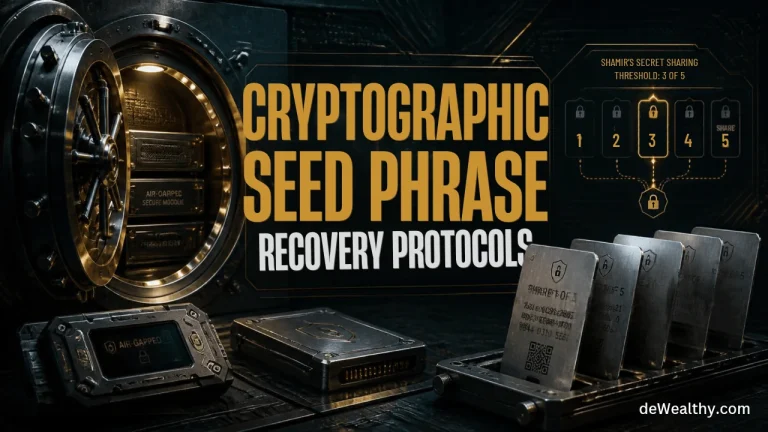
This is accomplished using SLIP-39 (Satoshi Labs Improvement Proposal 39), which utilizes Shamir’s Secret Sharing algorithm. A master seed phrase is mathematically divided into multiple distinct “shares” (e.g., a 3-of-5 threshold scheme). Any 3 shares combined can reconstruct the master wallet, but 1 or 2 shares alone reveal zero mathematical information about the underlying key.
[Master Family Vault Private Key]
       │
       ▼  (SLIP-39 Shamir 3-of-5 Split)
       ├─► Share 1: Held by Grantor (Primary Key)
       ├─► Share 2: Deposited in Bank Vault A (Swiss Safe Deposit)
       ├─► Share 3: Escrowed with Licensed Corporate Trustee
       ├─► Share 4: Held by Digital Asset Protector / Legal Counsel
       └─► Share 5: Deposited in Secure Vault B (Liechtenstein Foundation)
During the founder’s lifetime, they retain full operational control. Upon death or certified incapacitation, the Corporate Trustee and Digital Protector combine Share 3, Share 4, and Share 2 to recover the vault safely and distribute income to designated trust beneficiaries.
To examine the mathematical and physical setup of Shamir threshold shares across air-gapped hardware, read our comprehensive technical guide on SLIP39 estate planning.
4. Advanced Key Inheritance Protocols
Beyond mathematical key sharding, a family trust requires a clear operational protocol specifying how and when key recovery procedures are triggered. This includes dead-man-switch smart contracts, proof-of-death escrow triggers, and air-gapped physical vault access routines.
Discover how to build an airtight operational key inheritance plan combining dead-man switches with legal escrow in our deep dive on cryptographic seed phrase recovery protocols.
5. Sovereign European Foundations: Monaco and Liechtenstein
Selecting the correct international jurisdiction for a digital family trust is critical. High-net-worth families frequently combine Anglo-Saxon trust concepts with European civil foundations to maximize tax efficiency, privacy, and asset protection against foreign lawsuits.
Liechtenstein’s Token and DLT Services Act (TVTG) provides a statutory legal framework explicitly defining digital tokens within foundation laws, while Monaco offers unparalleled private wealth tax advantages. To explore how European foundations shield family holdings across generations, review our specialized analysis on Monaco crypto trust estate planning and our guide on Monaco and Liechtenstein foundations for digital assets.
6. Integrating Multi-Sig Vaults into Trust Governance
Once a digital asset family trust is legally established, its liquid capital must be managed in accordance with institutional security standards. Trust funds should never reside in single-signature wallets or unsegregated exchange accounts.
Family trusts deploy algorithmic multi-signature vaults programmed with withdrawal velocity limits, mandatory timelocks for large transactions, and multi-beneficiary sign-off requirements. To learn how automated rules prevent trustee abuse while maintaining liquidity, reference our technical breakdown of algorithmic governance in multi-sig vaults.
7. The Master Digital Estate Blueprint
Setting up an institutional digital asset family trust requires a structured, multi-disciplinary approach. Family offices should execute the following four-phase roadmap:
- Digital Inventory & Wallet Mapping: Catalog all liquid tokens, staked positions, private keys, hardware devices, and Web3 domain names into a secure, encrypted estate matrix.
- Jurisdictional Entity Structuring: Establish an offshore foundation or dynasty trust (e.g., Liechtenstein Stiftung) that defines legal beneficiaries and succession triggers.
- SLIP-39 Key Sharding Deployment: Execute a Shamir 3-of-5 or 4-of-7 key split across geographically isolated, air-gapped hardware vaults and licensed trustees.
- Bi-Annual Recovery Simulation: Conduct mandatory recovery drills requiring the trustee and trust protector to verify share validity without exposing the master key.