Cryptographic Seed Phrase Recovery Protocols
Cryptographic Seed Phrase Recovery Protocols: Advanced SLIP-39 & Trust Succession
The fundamental security rule of self-sovereign digital asset management—“never reveal your seed phrase to anyone”—creates a severe paradox for estate planning. If a founder keeps their 12 or 24-word recovery phrase completely secret, their death or sudden incapacitation permanently freezes family capital. Conversely, disclosing seed phrases to family members, attorneys, or traditional executors introduces immediate risks of theft, extortion, or premature disclosure. Resolving this paradox requires constructing formal cryptographic seed phrase recovery protocols that leverage SLIP-39 threshold mathematics, multi-jurisdictional escrow, and legally binding trust instructions.
1. The Mathematics of Threshold Cryptography: SLIP-39 vs. BIP-39
Most consumer cryptocurrency wallets utilize the BIP-39 standard, generating a single 12 or 24-word seed phrase. BIP-39 is an “all-or-nothing” security model: anyone who gains access to those 24 words possesses full control over the wallet’s funds. Copying a BIP-39 seed phrase onto multiple physical metal plates or splitting the 24 words into pieces (e.g., giving 12 words to person A and 12 words to person B) creates severe security flaws because 12 words can easily be brute-forced using modern hardware.
SLIP-39 (Satoshi Labs Improvement Proposal 39) resolves this by implementing Shamir’s Secret Sharing (SSS) algorithm at the mnemonic layer. SLIP-39 converts a master private key into a set of independent mnemonic shares (e.g., 20 words per share). It allows engineers to configure precise mathematical threshold parameters:
| Protocol Standard | Structure Type | Partial Share Vulnerability | Estate Succession Applicability |
|---|---|---|---|
| BIP-39 (Standard Mnemonic) | Single 12/24 Word String | Extreme; partial phrase reduces brute-force entropy drastically. | Poor; creates single point of failure and high theft risk. |
| BIP-39 Split (Naive Cut) | Word Segmentation (12 + 12) | High; 12 remaining words can be cracked in hours via GPU clusters. | Dangerous; non-standard and mathematically insecure. |
| SLIP-39 (Shamir Threshold) | M-of-N Mathematical Shards | Zero; individual shares reveal zero information about the master key. | Optimal; provides mathematical security and clear estate separation. |
2. Designing a 3-of-5 Institutional Recovery Matrix
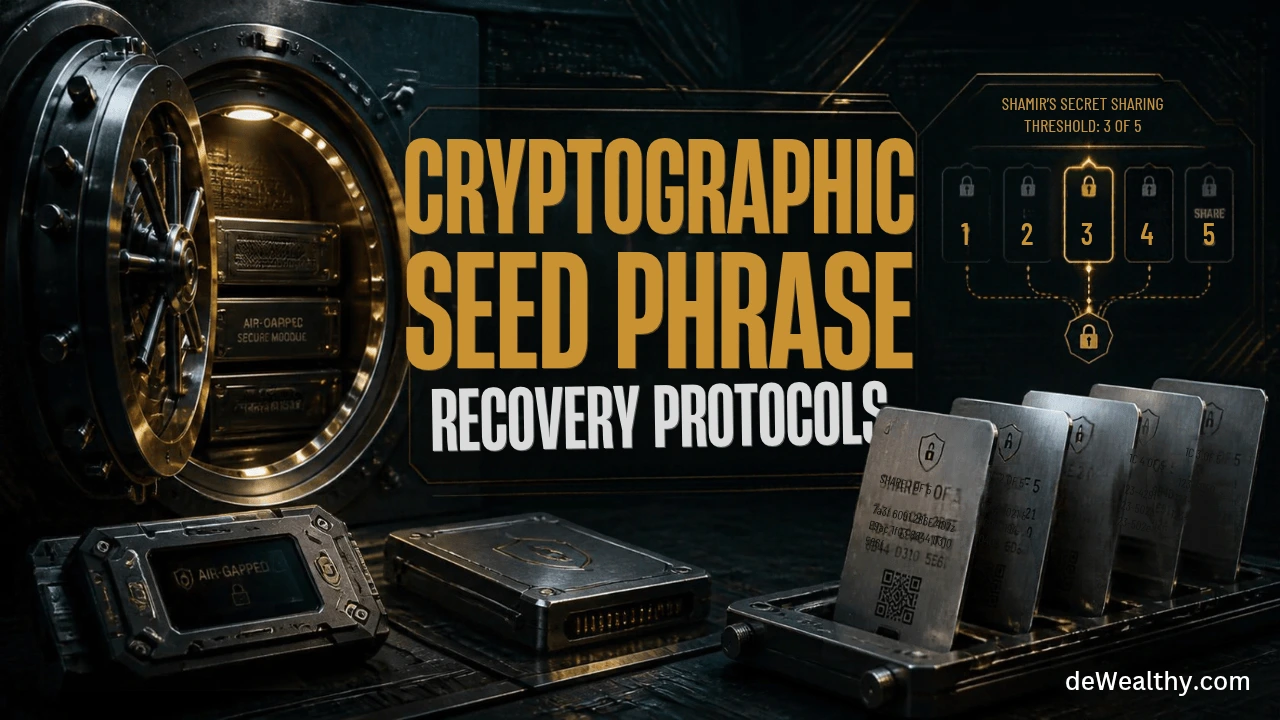
For high-net-worth estate planning, a 3-of-5 SLIP-39 share distribution scheme offers the ideal balance between security and redundancy. Under this configuration, 5 separate share mnemonics are generated, and any 3 shares must be brought together physically to restore the master wallet.
[SLIP-39 Master Key Generation] ──► 5 Unique Shares Generated (3 Required)
  │
  ├─► Share A: Principal Founder (Active Key) ──► Stored in Personal Home Safe
  ├─► Share B: Designated Heir (Primary Beneficiary) ──► Encrypted Metal Plate
  ├─► Share C: Licensed Corporate Trustee ──► Institutional Safe Deposit Vault
  ├─► Share D: Family Office Legal Counsel ──► Escrow Legal Deposit
  └─► Share E: Offline Safe Custody Hub (Zurich) ──► Deep Storage Vault
This structure guarantees complete security during the founder’s lifetime. If an attacker steals Share A from the founder’s home safe, they cannot access any funds because they lack the two additional shares required. If the founder unexpectedly passes away, the Corporate Trustee (Share C), Legal Counsel (Share D), and Heir (Share B) combine their shares during estate execution to recover the wallet safely.
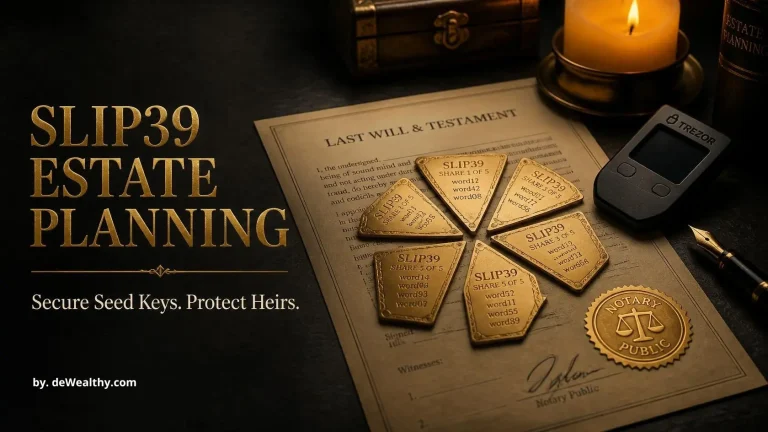
To learn more about implementing SLIP-39 hardware backups within estate plans, review our foundational guide on SLIP39 estate planning.
3. Dead-Man-Switch Smart Contracts and Hybrid Triggers
While physical key sharding secures seed phrases, an automated recovery protocol can also utilize on-chain “dead-man-switch” smart contracts. A dead-man-switch requires the wallet owner to execute a simple, low-cost transaction (a “ping”) at regular intervals (e.g., every 90 days).
If the wallet owner fails to ping the smart contract within the specified timeframe, the contract automatically shifts signature authority to a backup multi-sig setup or releases encrypted recovery keys held in smart contract escrow to designated trust beneficiaries.
4. Integrating Key Recovery into Family Trust Governance
Physical and smart contract recovery mechanisms must be anchored by legal trust documentation. A seed phrase recovery plan that operates outside a formal legal trust leaves keyholders vulnerable to tax penalties, probate court freezes, or breach-of-fiduciary disputes.
Seed recovery protocols should be embedded directly into an offshore or domestic trust agreement. To understand how key recovery aligns with overall trust administration, read our core manual on the digital asset family trust.
5. Sovereign European Jurisdiction Integration
The physical shares of a SLIP-39 recovery matrix should be distributed across top-tier international jurisdictions. Storing key shares across Switzerland, Liechtenstein, and Monaco ensures that localized court orders cannot force key reconstruction without multi-jurisdictional legal review.
For a detailed breakdown of how European trusts and civil foundations protect digital asset key recovery, explore our guides on Monaco crypto trust estate planning and Monaco and Liechtenstein foundations for digital assets.
6. Step-by-Step Implementation Guide for Family Offices
Executing a cryptographic seed phrase recovery protocol requires strict operational security. Family offices should follow this four-stage execution roadmap:
- Hardware Environment Preparation: Utilize an air-gapped, open-source hardware device (such as a Trezor Model T or Keystone) in an offline environment to generate SLIP-39 threshold shares.
- Physical Share Stamping: Engrave each SLIP-39 share share onto corrosion-resistant stainless steel or titanium plates to prevent physical destruction from fire or water damage.
- Escrow Deposit & Legal Alignment: Deliver physical shares to designated institutional trustees and legal escrows, accompanied by formal trust protocol instructions.
- Bi-Annual Verification Drills: Perform annual “health checks” requiring share custodians to confirm physical possession of their share plates without revealing mnemonic words or assembling the master key.