
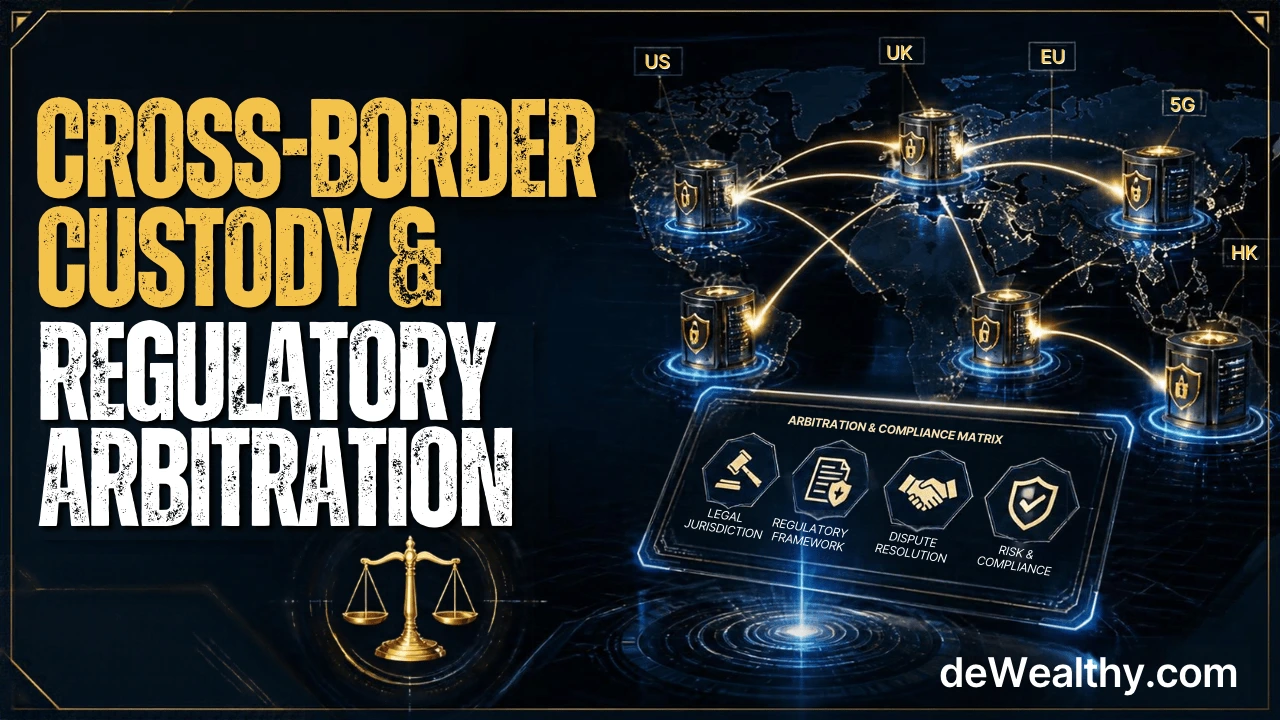
Cross Border Digital Asset Custody
Cross Border Digital Asset Custody: Regulatory Arbitrage & Multi-Jurisdiction Strategy
In an increasingly fragmented global financial ecosystem, high-net-worth individuals, sovereign wealth entities, and international family offices face an unprecedented operational dilemma. Managing liquid digital assets across international boundaries requires navigating a labyrinth of conflicting regulatory regimes, unilateral enforcement actions, and shifting tax implications. Mastering cross-border digital asset custody is no longer merely a legal compliance exercise—it is an essential strategic shield designed to preserve capital mobility, optimize international tax efficiency, and insulate wealth from localized geopolitical risks.
1. The Geopolitical and Regulatory Friction in Global Crypto Holdings
Digital assets operate on borderless, decentralized peer-to-peer networks that know no physical boundaries. However, the legal entities, physical keyholders, server nodes, and institutional custodians managing these assets reside strictly within physical nation-states. This fundamental mismatch creates severe geopolitical friction.
A single digital asset transaction executed by an international family office can simultaneously trigger legal jurisdiction in multiple countries:
- Jurisdiction of Incorporation: Where the fund, trust, or corporate holding entity is registered.
- Jurisdiction of Keyholders: Where the human signers or MPC node operators physically reside during transaction approval.
- Jurisdiction of Custodial Servers: Where the physical Hardware Security Modules (HSMs) or cloud servers housing key shards are located.
- Jurisdiction of Asset Settlement: The legal domicile of the underlying asset issuer (particularly critical in Real World Asset tokenization).
Without meticulous cross-border planning, family offices risk exposing their entire global portfolio to double taxation, sudden asset freeze orders issued by foreign courts, or aggressive extra-territorial regulatory actions by agencies like the US SEC or CFTC.
2. Strategic Regulatory Arbitrage: Legal Framework Optimization
Regulatory arbitrage is the strategic practice of structuring corporate entities, custodial hubs, and operational nodes across jurisdictions with favorable, stable, and clear legal environments. It is not about evading legal responsibilities; rather, it is about proactively selecting jurisdictions whose laws respect private property rights, provide legal certainty for cryptographic assets, and offer predictable fiduciary protections.
Tier-1 Jurisdictional Analysis for Digital Asset Custody
Leading global financial hubs have developed distinct competitive advantages for digital asset management:
| Jurisdiction | Regulatory Environment | Primary Legal Vehicle | Strategic Advantage |
|---|---|---|---|
| Switzerland (Zug / Zurich) | Highly Mature (FINMA Regulated) | Swiss Trust / Verein / DLT Entity | Rock-solid property rights, institutional banking integration, statutory legal certainty for segregation of digital assets in bankruptcy. |
| Liechtenstein | Comprehensive Token Act (TVTG) | Liechtenstein Foundation (Stiftung) | Complete separation of legal ownership from beneficial inheritance, ultimate asset isolation against external creditor litigation. |
| Singapore | Strict, Progressive (MAS Regulated) | VCC (Variable Capital Company) / Trust | Gateway to Asian liquidity, premier institutional fund management infrastructure, clear tax exemption frameworks for family offices. |
| United Arab Emirates (ADGM / DIFC) | Dedicated Digital Asset Regulators (FSRA/VARA) | DIFC / ADGM Prescribed Company / Foundation | Zero corporate/personal income tax on capital gains, strategic geographic position between Europe and Asia, robust common law court systems. |
3. Structuring the Multi-Jurisdictional Custodial Ring
Relying on a single jurisdiction—no matter how reputable—creates a single point of failure. If a country suddenly changes its tax laws, imposes capital controls, or experiences political instability, assets bound strictly to that region become trapped.
A sophisticated cross-border structure utilizes a “Custodial Ring Architecture,” dividing legal ownership, operational management, and cryptographic storage across three distinct legal zones:
[Zone 1: Ultimate Beneficial Holding]
  └─► Liechtenstein / Cayman Foundation (Protects Equity & Intergenerational Assets)
        │
        ▼
[Zone 2: Operational Treasury Management]
  └─► Swiss / UAE Holding Company (Manages Trading, Liquidity & DeFi Allocations)
        │
        ▼
[Zone 3: Distributed Multi-Jurisdictional MPC Key Infrastructure]
  ├─► Key Shard A: Swiss Vault (Secure Hardware Security Module)
  ├─► Key Shard B: Singapore Licensed Custodian (Co-signing Node)
  └─► Key Shard C: Distributed Air-Gapped Cold Vault (Offline Recovery)
In this tri-zone configuration, no single government or judicial body can unilaterally force a freeze or liquidation of the assets. A court order issued in one jurisdiction cannot force keyholders in another zone to compromise the threshold required to execute an unauthorized transaction.
4. Cross-Border Asset Isolation and Litigation Defense
Ultra-high-net-worth executives, tech founders, and family offices are prime targets for predatory lawsuits, marital dissolution disputes, and aggressive tax audits. When assets are held natively on transparent public ledgers, aggressive litigants can use sophisticated blockchain analytics to track wallet balances and seek global freezing orders (Mareva Injunctions).
To insulate liquid capital from arbitrary legal claims, digital assets must be integrated into international trust structures with strong asset protection statutes. To examine how European jurisdictions shield high-net-worth portfolios against external litigation, review our detailed analysis of Monaco digital asset custody governance.
5. Integration with Enterprise Governance Frameworks
A multi-jurisdictional custodial network cannot operate in isolation. It must seamlessly feed into an organization’s master risk policies, audit routines, and daily treasury operations.
Cross-border setups must adhere to strict reporting standards while preserving operational speed. For a comprehensive macro blueprint on structuring corporate hierarchy, key management protocols, and fiduciary compliance for large portfolios, read our core institutional digital asset framework.
6. Automated Programmatic Compliance in Cross-Border Transfers
Executing manual compliance checks across international boundaries creates significant operational bottlenecks, particularly when dealing with volatile digital asset markets. Furthermore, human errors in verifying recipient wallet compliance can lead to inadvertent sanctions violations (e.g., interacting with OFAC-sanctioned addresses).
Leading family offices resolve this by integrating automated programmatic compliance directly into their wallet infrastructure. By utilizing smart contract policy engines and multi-signature vaults, organizations can enforce automated pre-transaction checks. To learn how automated rules prevent unauthorized cross-border outflows, explore our technical breakdown of algorithmic governance in multi-sig vaults.
7. Practical Implementation: Step-by-Step Cross-Border Setup
Executing an international digital asset custody architecture requires methodical planning across legal, tax, and technical disciplines. Executive teams should follow this four-stage implementation strategy:
- Jurisdictional Mapping & Tax Assessment: Conduct a comprehensive tax audit to determine tax residence for beneficial owners and identify favorable international holding jurisdictions.
- Legal Entity Incorporation: Establish the top-tier asset protection vehicle (e.g., Liechtenstein Foundation or DIFC Prescribed Company) and establish bank accounts with crypto-friendly private banks.
- Custodial Vendor Selection & Key Sharding: Engage institutional MPC custodial providers operating across complementary jurisdictions (e.g., combining Swiss hardware security with Singapore co-custody).
- Policy Configuration & Disaster Recovery Drills: Program operational governance parameters (e.g., transaction caps, sign-off thresholds) and conduct biannual cross-border key recovery exercises.