Institutional Digital Asset Framework: Family Office Guide
Institutional Digital Asset
Framework
Institutional-grade governance, custody, and risk management for family offices and enterprises. A structural imperative, not a speculative gamble, in the 2026 digital asset landscape.
A multi-generational family office allocates $200M (15% of AUM) to digital assets. The investment committee, lacking formal governance, approves a high-yield staking protocol via a centralized, unregulated offshore exchange. When the exchange faces a liquidity crisis and halts withdrawals, the family office discovers a critical failure: there is no institutional digital asset framework in place. There is no independent custody, no multi-sig key management, no counterparty risk assessment, and no documented investment mandate limiting exposure to unregulated entities. The capital is indefinitely frozen. A properly engineered institutional digital asset framework prevents this by mandating qualified, regulated custody for the majority of holdings; enforcing strict governance and allocation limits approved by a fiduciary investment committee; and establishing fault-tolerant security protocols (like SLIP39 or institutional multi-sig) to eliminate single points of failure. The entire argument, in three lines:
- ▸Mandate qualified, regulated custody.
- ▸Enforce strict governance and allocation limits.
- ▸Establish fault-tolerant security protocols.
Why family offices need a formal digital asset framework
An institutional digital asset framework is not merely an investment strategy; it is a comprehensive operational, legal, and risk-management architecture. Unlike retail investors who can afford to experiment with self-custody and high-risk protocols, family offices and enterprises operate under strict fiduciary duties, regulatory scrutiny, and multi-generational wealth preservation mandates.
Without a formal framework, institutions face compounding vulnerabilities: regulatory non-compliance (e.g., violating MiCA or SEC guidelines), counterparty risk (exchange collapses), operational risk (lost private keys), and reputational damage. A robust framework synthesizes cryptography, fiduciary law, and systemic risk analysis into actionable intelligence, ensuring that digital asset exposure enhances, rather than jeopardizes, the family’s legacy.
Institutional digital asset exposure must be governed by the same fiduciary standards as traditional alternative investments. If a strategy cannot be audited, custodied securely, and legally defended, it does not belong in a family office portfolio.
Core components of an institutional-grade framework
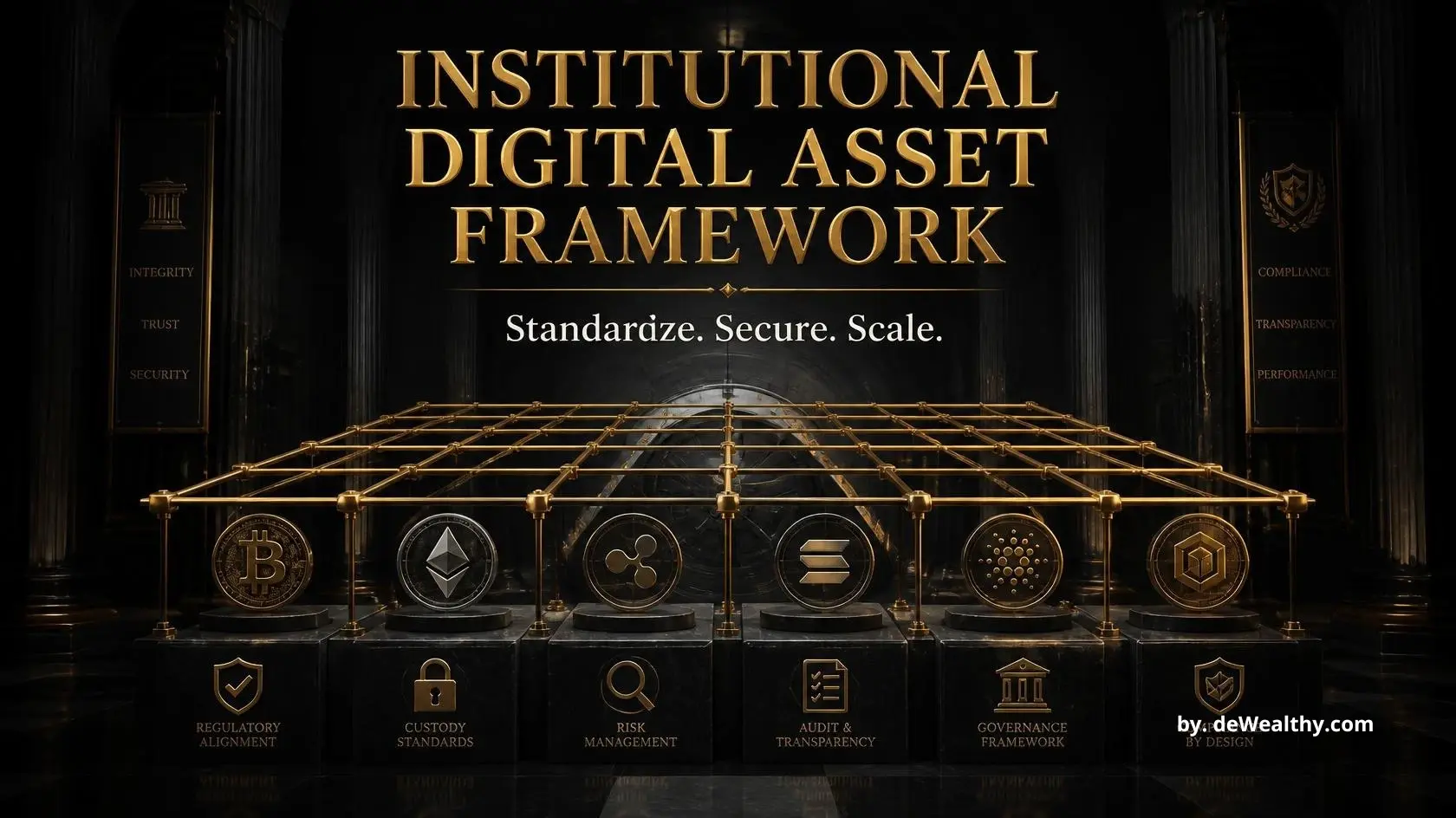
A comprehensive institutional digital asset framework rests on six interdependent pillars. Weakness in any single pillar compromises the entire architecture.
Governance Structure
Formal investment committee mandates, delegation of authority matrices, and documented decision-making protocols. Prevents rogue trading and ensures fiduciary alignment.
Custody Architecture
Utilization of qualified, regulated institutional custodians (e.g., Anchorage, Coinbase Institutional) or fault-tolerant self-custody (institutional multi-sig, MPC). Eliminates single points of failure.
Risk Management
Strict position sizing limits, volatility stress-testing, counterparty risk scoring, and liquidity provisioning. Ensures digital exposure does not threaten core portfolio stability.
Compliance & Reporting
Robust KYC/AML procedures, tax lot tracking, and adherence to evolving frameworks (e.g., MiCA in the EU, SEC/FINRA guidelines in the US). Ensures auditability and regulatory defense.
Security Protocols
Institutional-grade key management (e.g., SLIP39 Shamir’s Secret Sharing), cold storage air-gapping, and documented incident response plans for cyber threats.
Estate & Succession
Legal structures (e.g., digital asset trusts) and operational protocols ensuring seamless, secure transfer of digital wealth to next-generation beneficiaries without key loss.
Calibrating digital exposure to family office risk profiles
The institutional digital asset framework must dictate allocation limits based on the family office’s overarching risk tolerance, liquidity needs, and fiduciary mandate. We benchmark three primary institutional profiles:
| Institutional Profile | Target Allocation | Permitted Assets | Custody Mandate |
|---|---|---|---|
| Conservative (Preservation) | 1% – 5% of AUM | Bitcoin (BTC), Ethereum (ETH) only | 100% Qualified Institutional Custodian |
| Moderate (Balanced Growth) | 5% – 15% of AUM | BTC, ETH + Top 20 blue-chip protocols | 80% Qualified Custodian, 20% Institutional Multi-sig |
| Aggressive (Venture/Tech) | 15% – 30% of AUM | Diversified crypto + DeFi + Web3 VC allocations | Hybrid: Qualified Custody + Advanced Self-Custody (MPC/SLIP39) |
Selecting the right institutional custody solution
Custody is the cornerstone of the institutional digital asset framework. The choice between qualified third-party custodians and self-custody dictates the operational risk profile of the entire portfolio.
Qualified Custodians
Regulated entities (e.g., Anchorage Digital, Fidelity Digital Assets, Coinbase Institutional) offering insurance, audited proof-of-reserves, and fiduciary compliance.
Best for: Conservative/Moderate profiles, regulatory compliance, and large-scale AUM.
Institutional Self-Custody
Utilizing MPC (Multi-Party Computation) or institutional multi-sig (e.g., Gnosis Safe) with geographically distributed key shards and strict operational policies.
Best for: Aggressive profiles, DeFi participation, and families with deep technical expertise.
Hybrid Architecture
The institutional gold standard. Core holdings (80%+) in qualified custody for safety and auditability, with a tactical sleeve (20%-) in self-custody for yield or venture opportunities.
Best for: Balancing regulatory compliance with strategic flexibility.
Navigating multi-jurisdictional compliance
An institutional digital asset framework must be dynamically aligned with the regulatory regime of the family office’s domicile and the jurisdictions of its underlying assets.
European Union (MiCA)
The Markets in Crypto-Assets (MiCA) regulation provides a comprehensive framework. Family offices must ensure their custodians and trading venues are MiCA-licensed CASPs (Crypto-Asset Service Providers), ensuring strict AML, capital adequacy, and consumer protection standards.
United States (SEC / CFTC)
The US remains a complex patchwork. Family offices must navigate SEC securities laws (Howey Test), CFTC commodity regulations, and state-level money transmitter laws. Utilizing a “Qualified Custodian” under the Advisers Act is increasingly critical for fiduciary compliance.
Singapore (MAS)
The Monetary Authority of Singapore (MAS) offers a clear, progressive framework under the Payment Services Act. Family offices (e.g., under the 13O/13U schemes) benefit from regulatory clarity, provided they utilize MAS-licensed digital payment token services.
UAE (VARA / ADGM)
Dubai’s Virtual Assets Regulatory Authority (VARA) and Abu Dhabi’s ADGM provide bespoke, comprehensive virtual asset frameworks, making them highly attractive jurisdictions for institutional digital asset family office structuring.
Common institutional framework failures to avoid
- ✕No Formal Governance: Allowing portfolio managers to execute digital asset trades without documented investment committee approval or predefined allocation limits.
- ✕Single Point of Failure in Custody: Relying on a single hardware wallet, a single exchange, or a single individual holding all key shards without institutional multi-sig or SLIP39 distribution.
- ✕Ignoring Tax & Reporting: Failing to implement institutional-grade tax lot tracking and audit trails, leading to severe regulatory penalties and estate settlement nightmares.
- ✕Lack of Incident Response: Having no documented, tested protocol for responding to a cyber breach, lost key, or exchange insolvency.
Fifteen years designing institutional digital asset frameworks for multi-billion-dollar family offices and endowments. Former Chief Investment Officer specializing in alternative digital assets, with deep expertise in cryptographic custody, MiCA/SEC compliance, and fiduciary risk management.
- ✓Drafted by an institutional digital strategy desk; reviewed by certified cybersecurity and regulatory counsel
- ✓Frameworks benchmarked against 40+ active family office digital asset mandates (2024–2026)
- ✓Regulatory sections independently verified against current MiCA, SEC, and MAS guidelines
- EU Markets in Crypto-Assets Regulation (MiCA) — Official Journal of the EU, 2023
- SEC Staff Bulletin: Custody of Digital Asset Securities by Registered Investment Advisers
- MAS Notice PSN02: Prevention of Money Laundering for Digital Payment Token Services
- NIST Special Publication 800-217: Risk Management for Smart Contracts
- SLIP-0039: Shamir’s Secret-Sharing for Mnemonic Codes
Institutional digital wealth is not built on speculation. It is engineered on framework, custody, and governance.