Institutional Digital Asset Framework 2026
Institutional Digital Asset Framework 2026: The Definitive Wealth Protection Standard
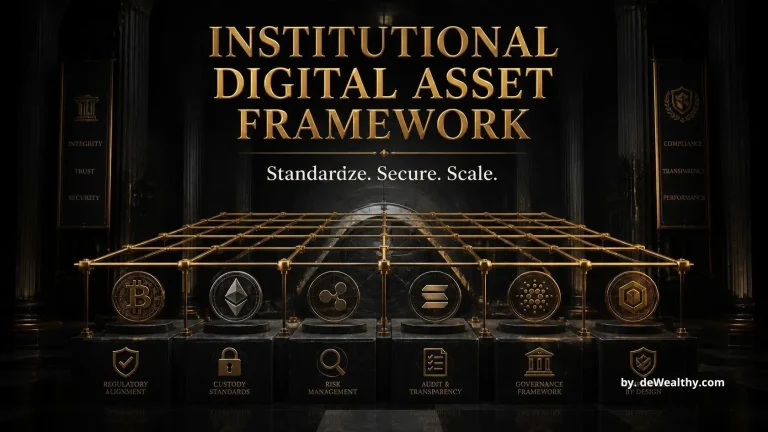
As sovereign balance sheets, multi-family offices, and tier-one funds scale their exposure to decentralized ecosystems, legacy wealth management infrastructure is failing under the weight of cryptographic complexity. Managing high-net-worth digital portfolios requires moving far beyond basic multi-signature wallets and offline cold storage. A truly resilient institutional digital asset framework demands a holistic synthesis of multi-jurisdictional legal architecture, fault-tolerant cryptographic engineering, post-quantum readiness, and automated governance protocols.
1. The Paradigm Shift: Why Legacy Fiduciary Standards Fail in Digital Wealth
For centuries, institutional wealth preservation relied on well-trodden legal paths: clearinghouses, custodial banks, legal trusts, and centralized registrar systems. In these traditional environments, asset recovery is governed by legal recourse, judicial court orders, and administrative reversals. If a wire transfer is fraudulently executed, legal systems contain built-in clawback mechanisms.
Cryptographic assets invert this paradigm completely. On public blockchain ledgers, settlement is final, irreversible, and execution-based. The fundamental axiom shifted from “possession governed by legal title” to “possession dictated by cryptographic control.” Consequently, an operational or technical failure in managing private keys results not merely in a temporary loss of liquidity, but in total, permanent capital extinction.
Family offices and institutional treasuries frequently commit the mistake of applying traditional fiduciary oversight to cryptographic assets. Treating a $100M digital asset portfolio with simple consumer-grade hardware wallets or single-entity custody contracts introduces massive single-point-of-failure vulnerabilities. A modern institutional framework must address four existential risk categories:
- Cryptographic & Key Management Risk: Theft, key decay, physical duress, or destruction of seed material.
- Regulatory & Legal Arbitrage Risk: Unilateral asset freezes, cross-border jurisdictional conflicts, and changing tax treatments.
- Counterparty & Custodial Insolvency Risk: The catastrophic failure or bankruptcy of centralized custodial intermediaries.
- Governance & Operational Bottlenecks: Human error, insider collusion, and inefficient approval workflows during high-volatility market events.
2. Architectural Foundations of an Enterprise-Grade Digital Asset Framework
To withstand systemic financial shocks, targeted state-level cyberattacks, and internal fraud, an institutional framework must be constructed across three distinct, interconnected layers: Technical Security, Legal Governance, and Operational Continuity.
Layer 1: The Technical & Cryptographic Security Layer
The base layer focuses on protecting key material across its entire lifecycle: generation, storage, signing, and rotation. Legacy single-key setups and naive M-of-N multi-signature configurations are insufficient for institutional treasuries managing capital across multiple blockchain ecosystems.
Institutions must adopt advanced Multi-Party Computation (MPC) paired with hardware security modules (HSMs). Unlike traditional multi-sig, where separate transactions are published on-chain (exposing organizational vault structure and wallet addresses to public scrutiny), MPC divides a single private key into multiple mathematical shards. These shards compute signatures collaboratively without ever reassembling the full key in memory or revealing governance rules to public ledgers.
Layer 2: The Legal & Multi-Jurisdictional Layer
Cryptographic protection is meaningless if the legal entity holding the assets is vulnerable to aggressive litigation, regulatory overreach, or arbitrary freezing orders. Digital assets must be held within bespoke legal vehicles designed specifically for digital assets, such as Liechtenstein Foundations, Cayman Islands Foundation Companies, or Swiss Trusts.
These legal structures separate beneficial ownership from operational execution. Furthermore, establishing clear legal title across jurisdictions shields capital from creditor claims in the event of third-party platform insolvencies.
Layer 3: The Operational & Human Governance Layer
Human operational failure accounts for over 80% of institutional digital asset losses. The operational layer defines role-based access control (RBAC), separation of duties, and mathematical checks on human authority. No single individual—regardless of executive title or ownership stake—should possess the ability to unilaterally move institutional capital.
3. Comparative Matrix: Enterprise Custody Architectures
Selecting the correct custodial model requires balancing operational flexibility with absolute security. The table below outlines the trade-offs across major institutional custodial models:
| Custody Model | Control Level | Primary Vulnerability | Optimal Use Case |
|---|---|---|---|
| Fully Centralized Qualified Custodian | Low (Third-Party Dependent) | Regulatory freezes, custodial bankruptcy, asset rehypothecation | Regulatory compliance for traditional funds with restricted mandates |
| Self-Sovereign On-Chain Multi-Sig | Absolute (Direct On-Chain) | Public transaction footprint, high gas fees, smart contract exploits | Native Web3 organizations, DeFi operations, treasury management |
| Institutional Hybrid MPC + HSM | High (Programmatic Co-Custody) | Complex operational setup, vendor API dependencies | Multi-family offices, high-frequency funds, sovereign treasuries |
4. Implementing Fault-Tolerant Key Architecture
True resilience means the framework continues to function flawlessly even when key infrastructure components fail, are destroyed, or become compromised. A robust key management architecture utilizes redundant geographical distribution, air-gapped signing environments, and physical key sharding across secure vaults worldwide.
To eliminate single-point-of-failure risks in hardware and physical key storage, institutions must deploy multi-tiered key distribution matrices. To understand how multi-layered physical and software redundancy protects capital against catastrophic events, review our detailed guide on fault-tolerant crypto custody.
5. Cross-Border Regulatory Navigation & Jurisdictional Arbitrage
In an era of fragmenting geopolitical alliances, a static approach to regulatory compliance is dangerous. Regulatory arbitrage involves strategically establishing holding structures and custodial setups across multiple jurisdictions to maximize operational freedom while maintaining legal compliance.
An asset protection structure might situate the ultimate holding foundation in Liechtenstein, utilize custodial infrastructure in Switzerland, and execute liquidity operations through regulated entities in Singapore. For an in-depth analysis of how international entities leverage compliance disparities legally while guarding against cross-border asset freezes, read our dedicated guide on cross-border digital asset custody.
6. Programmatic Security: The Evolution of Algorithmic Governance
As institutional treasuries grow in size and operational complexity, relying manually on executive sign-offs for routine transactions introduces massive inefficiencies and severe security risks under coercion scenarios. The modern institutional standard is shifting from human discretion to algorithmic policy enforcement.
Algorithmic governance allows family offices to embed discretionary parameters—such as transaction velocity limits, automated timelocks, whitelist requirements, and multi-signature escalation triggers—directly into smart contracts or MPC policy engines. Discover how automated risk protocols operate within enterprise structures in our technical breakdown of algorithmic governance in multi-sig vaults.
7. Intergenerational Succession and Digital Asset Trusts
A major flaw in current institutional crypto setups is the lack of seamless succession planning. Millions of dollars in digital wealth have been rendered permanently inaccessible upon the unexpected incapacity or passing of key founders. Traditional wills and testament documents are entirely inadequate because writing private keys or seed phrases on paper introduces immediate physical theft vectors.
Modern succession requires combining digital asset trust structures with cryptographic splitting techniques (such as Shamir’s Secret Sharing or SLIP-39 protocol). This ensures that heirs and trust executors can regain access to funds only upon fulfilling legal and proof-of-death verification procedures, without exposing raw key material during the founder’s lifetime.
8. Post-Quantum Cryptography: Preparing for the Next Technological Horizon
While current cryptographic standards (such as Elliptic Curve Cryptography ECDSA secp256k1) remain secure against classical computing threats, the emergence of quantum computing poses a severe mid-term risk. Quantum algorithms (specifically Shor’s Algorithm) will eventually possess the power to derive private keys directly from public keys exposed on public ledgers.
An forward-thinking institutional framework built in 2026 must actively prepare for quantum resilience. This involves migrating treasury vaults to post-quantum signature schemes (such as hash-based stateful signatures or lattice-based cryptography) and implementing zero-knowledge proof protocols that obscure public key footprints until settlement occurs.
9. Executive Action Plan for Implementing the Framework
Transitioning an organization from informal digital asset management to an enterprise-grade framework requires a systematic, phased deployment. Executive teams should execute the following four-phase roadmap:
- Comprehensive Risk Audit: Map all digital asset holdings, private key locations, current custodian agreements, and single-point-of-failure vulnerabilities.
- Legal & Entity Restructuring: Establish offshore foundation or trust entities in top-tier digital asset jurisdictions to isolate personal liability from treasury management.
- Custodial Infrastructure Deployment: Transition from simple multi-sig or single-custodian setups to a multi-provider MPC + HSM infrastructure integrated with automated governance policies.
- Disaster Recovery & Succession Testing: Perform quarterly simulated drills testing physical vault compromises, keyholder incapacitation, and cross-border regulatory freeze scenarios.