
Digital Asset Regulatory Navigation: Family Office Compliance
Digital Asset Regulatory
Navigation
Ensure global compliance. Digital asset regulatory navigation helps family offices legally structure cross-border crypto investments.
FRAGMENTED · State vs. Federal overlap
SUBSTANCE · Requires local physical presence & directors
TL;DR — the map is not the territory
A family office in Singapore holds utility tokens issued by a foundation in the Cayman Islands, traded on a platform registered in the EU, with beneficiaries residing in the United Kingdom. Which regulator claims jurisdiction? The uncomfortable answer is: all of them, simultaneously, and they disagree on what the asset actually is. The blockchain ignores borders; the law does not. A robust digital asset regulatory navigation framework is the only way to prevent a compliance failure in one timezone from unravelling a tax strategy in another. It allows a family to navigate cross-border crypto laws without accidentally triggering a money-transmitter registration in a US state they have never visited; it forces the family office to ensure family office global compliance against incoming regimes like CARF and MiCA before the reporting deadlines hit; and it provides the blueprint to structure offshore digital asset entities with the genuine economic substance that modern regulators demand. The entire argument, distilled to its essence:
Verbatim · retain as written
- Navigate cross-border crypto laws.
- Ensure family office global compliance.
- Structure offshore digital asset entities.
Borderless assets, heavily bordered laws
The foundational myth of early crypto was regulatory arbitrage — the idea that code could outrun the state. That era closed definitively with the introduction of the FATF Travel Rule, the EU’s MiCA framework, and the OECD’s CARF protocol. Today, regulatory exposure is not determined by where the server sits, but by where the beneficial owner resides, where the fiat on-ramp touches the banking system, and where the marketing materials are read. The 2026 Executive Digital Asset Risk Index confirms that regulatory misclassification has now overtaken technical failure as the primary vector of wealth destruction for private clients.
“The protocol was decentralized. The family office, the bank account, and the beneficiaries were not. The regulator only needed to find one of them.”Composite enforcement pattern · fiduciary intake interviews
The five layers of regulatory navigation
Compliance is not a single checkbox; it is a stack. A failure at any layer compromises the entire structure, which is why this framework must be designed in tandem with the digital asset trust structure and the SLIP39 key architecture.
Classification
Asset Taxonomy & The Howey / MiCA Tests
Before a structure can be built, the assets must be named in the eyes of the law. A token that is a utility in Switzerland may be a security in the United States and a regulated e-money token in the EU. The classification dictates the reporting regime, the permissible custody providers, and the marketing restrictions.
- Line-by-line asset classification against SEC, ESMA, and MAS frameworks
- Identification of “payment tokens” vs “security tokens” vs “e-money”
- Documentation of the classification rationale for future audits
Licensing
MSB, VASP & The Economic Substance Test
Holding your own assets rarely triggers licensing. Managing assets for a trust, a foundation, or multiple family members across borders often does. Offshore jurisdictions like the Cayman Islands and BVI now demand genuine economic substance — local directors, physical offices, and audited operating expenses — to maintain a Virtual Asset Service Provider (VASP) registration.
- Money Services Business (MSB) / FinCEN registration audits (US)
- Economic substance filings for Cayman & BVI holding entities
- Exemptions for purely proprietary, non-commercial family offices
Reporting
CRS, FATCA & The CARF Horizon
The era of offshore opacity is over. The Common Reporting Standard (CRS) already captures traditional financial accounts; the incoming Crypto-Asset Reporting Framework (CARF) will mandate cross-border reporting of crypto transactions directly to tax authorities. The infrastructure to capture cost-basis, wallet addresses, and transaction hashes must be built now.
- Wallet-to-identity mapping for CRS/FATCA self-certifications
- CARF readiness: automated harvest of transaction data for 2026+ reporting
- Integration with the family’s existing tax preparers and legal counsel
Marketing
Financial Promotions & Cross-Border Solicitation
A family office does not “market” in the traditional sense, but sharing a private placement memo for a tokenized fund with a relative in the UK can violate the FCA’s Financial Promotions Order. Regulatory navigation requires strict information barriers between the family’s investment activities and their external communications.
- Gating mechanisms for private deal flow and tokenized syndicates
- Review of family office websites and LinkedIn presences for regulatory triggers
- Whitelisting of professional client status across jurisdictions
Governance
Board Frameworks & AI Oversight
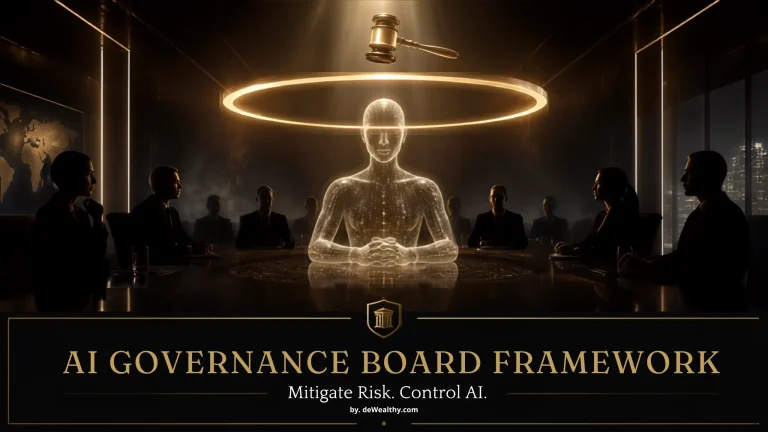
Regulators increasingly look at the decision-makers, not just the entities. A robust AI governance board framework ensures that if the family office uses algorithmic trading or automated DeFi yield strategies, the board retains human oversight, satisfying emerging fiduciary duties around automated financial systems.
- Board minutes reflecting deliberate regulatory risk acceptance
- Veto rights over interactions with unregistered or high-risk protocols
- Annual third-party compliance audits, separate from financial audits
Mapping the regulatory perimeter
| Jurisdiction | Primary Framework | Stablecoin Stance | DeFi / Unhosted Wallets | Family Office Exemption |
|---|---|---|---|---|
| European Union MiCA | Harmonized EU-wide licensing & consumer protection | Strict reserve requirements; EUR stablecoins favored | Regulated CASPs must monitor unhosted wallet transfers | Limited; proprietary trading exempt, third-party management requires license |
| United Kingdom FCA | Property law recognition; bespoke Financial Promotions regime | Consulting on Sterling-backed stablecoin regulation | Travel rule applies; strict marketing restrictions for retail | Recognized; but cross-border solicitation heavily policed |
| United States SEC/CFTC | Howey Test (Securities) vs Commodity; state-by-state MSB laws | Bipartisan legislative push for payment stablecoin frameworks | High enforcement risk; OFAC sanctions strictly applied to protocols | Family Office exemption under Dodd-Frank, but state MSB laws vary |
| Singapore MAS | Payment Services Act (PSA); Digital Payment Token licensing | Prohibited retail lending of crypto; strict custody rules | Travel rule enforced via TRUST protocol; AML/CFT focus | Single Family Offices (SFOs) exempt under specific tax schemes (13O/13U) |
| Cayman Islands VASP | Virtual Asset (Service Providers) Act; Economic Substance | Permitted within licensed entities; no central bank digital currency | Follows FATF guidelines; relies on VASP registration | Requires local substance if managing third-party or trust assets |
Local statutes, global consequences
The digital asset trust structure travels well; the regulatory perimeter does not. Read your jurisdiction’s specific friction points.
For UK readers — the Financial Promotions trap
Financial Services and Markets Act 2000 · FCA Handbook · Property (Digital Assets etc.) Act 2025
For UK readers, the immediate danger is rarely the holding of the asset; it is the communication about it. The FCA’s Financial Promotions Order strictly prohibits the marketing of unregulated crypto assets to UK retail clients. While a private family office is not “marketing,” sharing deal flow, tokenized real estate fractions, or private syndicate memos with extended family members who do not meet the strict “High Net Worth” or “Sophisticated Investor” definitions can inadvertently breach the perimeter. Where disputes over these promotions or smart contracts arise, families increasingly rely on smart contract dispute resolution frameworks and third-party litigation funding.
How the structure adapts
- Audit all family office communications and data rooms for FCA promotion triggers.
- Ensure every beneficiary interacting with the structure has documented professional investor status.
- Pair the regulatory map with the personal wrapper: ISAs shelter the fiat sleeve; trusts handle the digital.
In Canada — provincial securities and the CARF horizon
Securities Act (Provincial) · CSA Staff Notices · Income Tax Act · FINTRAC
In Canada, this works differently: there is no single national securities regulator. The Canadian Securities Administrators (CSA) issue guidance that each province (Ontario, BC, Quebec) enforces with varying degrees of aggression. Furthermore, Canada is an early adopter of the OECD’s CARF. Canadian families must assume that every transaction executed on a foreign exchange will be reported back to the CRA. If the cost-basis records are not immaculate, the deemed disposition at death will be calculated on the gross proceeds, not the gain.
How the structure adapts
- Classify every token against CSA Staff Notice 46-308 (Substance over form).
- Register with FINTRAC if the family office structure crosses into MSB territory.
- Use TFSAs and RRSPs for the traditional core; keep the digital sleeve strictly documented for CRA audits.
Australia — AUSTRAC and the AFS licensing threshold
Corporations Act 2001 · ASIC regulatory guides · AUSTRAC AML/CTF Rules
Australia draws a hard line between “digital currency” (treated as property/GST-free) and “digital financial products” (derivatives, tokenized securities). If the family office structure begins managing a tokenized fund or offering yield products, it likely requires an Australian Financial Services (AFS) license. Meanwhile, AUSTRAC requires strict AML/CTF compliance for any entity acting as a digital currency exchange, and the definition of “exchange” has broadened significantly.
How the structure adapts
- Audit the portfolio: separate pure payment tokens from tokenized securities.
- Ensure superannuation (SMSF) holdings strictly adhere to the sole-purpose test and ASIC guidance.
- Maintain a high-interest fiat buffer in regulated ADIs for probate liquidity.
New Zealand — the FMA and the FSPR register
Financial Markets Conduct Act 2013 · FSPR registration · Trusts Act 2019
New Zealand’s Financial Markets Authority (FMA) has issued clear warnings against misclassifying security tokens as utility tokens to avoid the Financial Markets Conduct Act. Additionally, any entity providing financial services must register on the Financial Service Providers Register (FSPR). For families utilizing NZ trusts, the regulatory navigation must align with the disclosure duties of the Trusts Act 2019 — beneficiaries may have a legal right to know the regulatory status of the entities the trust is investing in.
How the structure adapts
- Register on the FSPR if the family office provides administrative services to the trust.
- Document the FMCA exemption relied upon for any private token placements.
- Align the regulatory disclosures with the trust’s beneficiary communication strategy.
United States — the Howey test and the state patchwork
Securities Act of 1933 · Commodity Exchange Act · Bank Secrecy Act · State Money Transmitter Laws
For US families, the federal layer is a turf war between the SEC (securities) and the CFTC (commodities), governed by the Howey Test. But the hidden trap is at the state level. Moving value across state lines for the benefit of a multi-generational trust can inadvertently trigger Money Transmitter licensing requirements in states like New York (the BitLicense) or California. If a family member is injured while traveling to a fiduciary meeting, the estate’s exposure expands — a reason our executive car accident brief often sits in the same compliance binder.
How the structure adapts
- Obtain formal legal opinions on the Howey status of significant illiquid token holdings.
- Structure trust distributions to avoid triggering state-level money transmission definitions.
- Ensure D&O insurance for the family office board covers regulatory defense costs — often bundled with high-value property policies.
The registered-sleeve library
Canada · Passive coreBest index funds in Canada: XEQT & VGROBuilding the compliant, traditional core of the family office portfolio.
UK · Tax wrappersISA investing for beginnersSheltering sterling from IHT while the digital assets sit in trust.
UK · Household systemsBest UK budgeting appsThe operational tools for maintaining the household’s fiat liquidity.
Australia · SequencingSuperannuation vs ETF investingNavigating the strict regulatory boundary between SMSFs and personal crypto.
Australia · LiquidityHigh-interest savings accounts AUProbate liquidity buffers held in APRA-regulated institutions.
New Zealand · RetirementKiwiSaver vs index fundsAligning retirement vehicles with the FMA’s disclosure expectations.
Method · SeriesThe compliance perimeter methodHow regulatory mapping integrates with trust and key architecture.
Three ways the perimeter is breached
The accidental money transmitter
A US-based family office routinely converted stablecoins to fiat to pay the living expenses of beneficiaries in three different states. Because the office held the exchange accounts and distributed the funds, a state regulator classified them as an unlicensed money services business, freezing the accounts and imposing daily fines.
The fix: Distributions routed through a licensed, third-party trust company acting as the disbursement agent, removing the family office from the transmission chain.
The phantom substance
A Cayman VASP entity was established to hold the family’s exchange accounts and qualify for tax neutrality. However, the entity had no local directors, no physical office, and all decisions were made via Zoom from London. When the registry audited the Economic Substance requirements, the entity was struck off, triggering a chaotic retitling of assets.
The fix: Appointing local, regulated corporate directors and leasing physical office space, satisfying the substance test and protecting the entity’s legal standing.
The unhosted wallet blindspot
A European family office used a hardware wallet to interact with a DeFi protocol. Under the new MiCA and FATF Travel Rule interpretations, the regulated on-ramp they used was required to verify the ownership of the unhosted wallet. Because the wallet was held in the name of the settlor personally, not the trust, the on-ramp froze the transaction and filed a Suspicious Activity Report.
The fix: Generating cryptographic proof of wallet ownership (a signed message) tied to the trust’s legal identity, and maintaining a registry of all trust-owned unhosted addresses.
The 90-day compliance build
-
Perimeter mapping
Identify every jurisdiction where the family, the fiduciaries, the servers, and the on-ramps reside. Map the flow of fiat and the flow of tokens.
Weeks 1–3
-
Asset classification
Classify every holding against the Howey test, MiCA taxonomy, and local equivalents. Document the rationale for each classification.
Weeks 4–6
-
Substance & licensing audit
Determine which entities require VASP registration, MSB licensing, or Economic Substance filings. Initiate the applications.
Weeks 7–9
-
Reporting infrastructure
Deploy the software and operational procedures required to harvest transaction data for CRS, FATCA, and the incoming CARF protocols.
Weeks 10–12
-
Structural realignment
Decant or restructure trusts and holding companies to align with the regulatory map. Ensure the SLIP39 share map reflects the new legal entities.
Week 13
Asked at the compliance table
No. Every major jurisdiction has its own classification — property, currency, commodity, security, or payment instrument — and each classification triggers different reporting, licensing and tax obligations. Assuming uniformity is the single most expensive mistake in cross-border digital wealth.
MiCA is the EU Markets in Crypto-Assets regulation, fully in force from December 2024. It applies to any crypto-asset service provider operating in the EU, regardless of where it is incorporated. Non-EU family offices dealing with EU residents or EU-based custodians must comply.
Generally no — holding your own assets is not transmission. But the moment a family office structure begins managing crypto for multiple beneficiaries across state or national lines, it may cross into regulated territory. The line is fact-specific and jurisdiction-specific.
The Common Reporting Standard already requires cross-border financial account reporting; CARF extends this to crypto-asset transactions from 2026. Offshore structures that believed they were opaque must now assume transparency is the default, and design accordingly.
Yes — most common-law jurisdictions recognize crypto as property through case law even without specific legislation. But the absence of statute creates uncertainty in enforcement, which is why families often pair trust structures with jurisdictions that have explicit digital-asset frameworks.
Regulation governs what you may do (licensing, reporting, custody standards); taxation governs what you owe. A structure can be perfectly regulated and still trigger unexpected tax, or tax-efficient but regulatory non-compliant. Both layers must be designed together.
Who stands behind this dossier
Methodology & standards
- Human-drafted, practitioner-reviewed line by line before publication.
- Statutory references checked against primary instruments at review date.
- Regulatory frameworks are subject to rapid change; this dossier reflects the law as of August 2026.
- Material regulatory change triggers an out-of-cycle update.
The series · internal reading order
№ 17 · Digital Asset Trust Structure
№ 18 · SLIP39 Estate Planning
№ 19 · Regulatory Navigation (this dossier)
№ 20 · AI Governance Board Framework
№ 21 · High-Value Condo Insurance Bundling
№ 22 · Digital Asset Litigation Funding
№ 23 · Smart Contract Dispute · RWA
№ 24 · Executive Car Accident Lawyer
Data · 2026 Executive Digital Asset Risk Index
Hub · All Insights
Educational commentary, not legal, tax or investment advice. Engage qualified counsel in each relevant jurisdiction before acting. Full disclaimer applies.
Map the perimeter before the regulator maps it for you.
Family offices and trustees can request the Regulatory Perimeter Matrix — a working spreadsheet covering asset classification tests, economic substance requirements, and the 2026 CARF reporting calendar.
Response within 48 hours · NDA on request · No legal representation offered through this publication
/digital-asset-regulatory-navigation
© 2026 DeWealthy · Disclaimer · Privacy