
Monaco Crypto Trust Rules: 2026 Estate Guide for HNWIs
Monaco Crypto Trust Estate Planning: 2026 Legal Framework & Multi-Sig Custody for HNWIs
For High-Net-Worth Individuals (HNWIs), ultra-wealthy family offices, and institutional investors, sovereign digital wealth represents both an unprecedented engine for capital accumulation and a fragile asset class highly vulnerable to structural friction. While traditional wealth preservation strategies rely heavily on legacy banking networks, physical land registries, and probate courts, non-custodial digital assets—such as Bitcoin, self-custodied Ethereum protocols, tokenized Real World Assets (RWAs), and decentralized finance liquidity stakes—operate under cryptographic laws that ignore conventional legal constructs.
Without a meticulously crafted estate architecture, digital assets are exposed to catastrophic loss upon an owner’s incapacity or demise. Probate delays, judicial subpoenas, lost private keys, and cross-border inheritance taxation can instantly dissolve generational wealth. To solve this paradox, sovereign investors are combining modern cryptographic governance with the premier private wealth jurisdiction in Europe: The Principality of Monaco.
This comprehensive operational guide details the Monaco crypto trust estate planning rules, examining how Monaco Law No. 214 interacts with institutional multi-signature key management, European Union MiCA regulatory frameworks, and private asset protection protocols.
Institutional Foundation: This strategic guide serves as an advanced jurisdictional module of deWealthy’s primary framework on Digital Estate Planning & Asset Protection.
Executive Summary: Legacy Probate vs. Monaco Digital Asset Trust
Before evaluating regulatory intricacies, C-suite executives and family office trustees must understand the structural shift required to transition from traditional probate mechanisms to a Monégasque cryptographic trust framework.
| Architectural Vector | Traditional Will & Local Probate | Monaco Crypto Trust Structure |
|---|---|---|
| Probate Court Exposure | Public record, multi-year court freezes | Private non-probate transfer via trustee fiduciary mandate |
| Private Key Sovereignty | Exposed to executor error & legal discovery | Distributed multi-sig governance & dead-man smart contracts |
| Creditor & Litigation Firewall | Vulnerable to domestic attachment orders | Protected under Monaco Law No. 214 asset protection provisions |
| Direct Inheritance Tax | Up to 40%–55% in primary Tier-1 jurisdictions | 0% for direct linear heirs (parents, spouses, children) in Monaco |
| Operational Execution | Manual court filings & bank authorizations | Automated cryptographic quorum execution |
Section 1: The Jurisdictional Supremacy of Monaco Law No. 214
Monaco has long maintained its standing as the sovereign capital of European wealth preservation. However, its value proposition for digital asset holders extends far beyond its favorable personal tax environment (0% income tax, 0% capital gains tax, and 0% wealth tax for residents).
The true structural cornerstone for digital estate planning is Monaco Law No. 214 of April 29, 1936 (as amended). Law No. 214 allows foreign nationals residing in Monaco—or non-residents establishing trusts through licensed Monaco financial institutions—to create private trusts governed by their domestic national law (e.g., English Common Law, Delaware Trust Law, or Liechtenstein Foundation Law), while anchoring the trust’s legal seat and asset custody firmly within Monaco’s sovereign judicial umbrella.
Key Statutory Protections under Law No. 214:
- Statutory Shield Against Foreign Forced Heirship Rules: Monaco courts refuse to recognize foreign forced heirship mandates (réserve héréditaire) imposed by jurisdictions such as France, Germany, or civil law states. HNW settlors retain absolute freedom of testation over their digital portfolios.
- Absolute Fiduciary Confidentiality: Trust registers in Monaco are shielded from public disclosure. Unlike public company registries or probate court dockets, the trust deed, beneficiary identities, and ledger balances remain strictly confidential between the settlor, the trustee, and the Commission de Contrôle des Informations Nominatives (CCIN).
- Impenetrable Creditor Firewalls: Future third-party creditors or foreign litigants cannot easily attach claims to assets lawfully settled into a Monaco trust, provided the transfer was not executed with fraudulent intent at the time of settlement.
Section 2: Cryptographic Key Governance & Multi-Sig Vault Architecture
A legal contract cannot sign a blockchain transaction. A primary failure point in conventional HNW estate planning occurs when attorneys draft elaborate legal wills without understanding private key mechanics. If private keys are stored in a single hardware wallet, a safety deposit box, or an unencrypted document, the estate is exposed to either complete theft or irreversible key loss upon the settlor’s death.
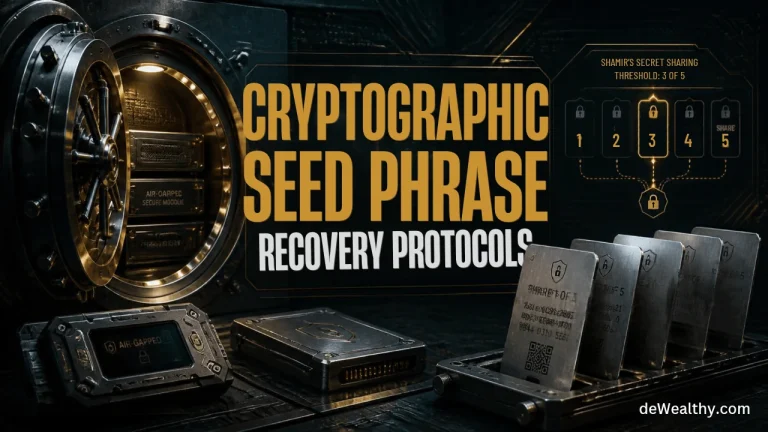
Monaco digital asset trusts eliminate single points of failure by pairing Law No. 214 with a 3-of-5 Institutional Multi-Signature (Multi-Sig) Threshold Scheme.
               [ HNW Settlor Key ] (Key 1)
                       │
       ┌───────────────┼───────────────┐
       ▼               ▼               ▼
[Monaco Trustee] [Legal Counsel] [Smart Contract]
    (Key 2)          (Key 3)         (Key 4)
                       │
                       ▼
            [Swiss Cold Storage] (Key 5)
Key Distribution Breakdown:
- Key 1 (Settlor Operational Key): Controlled solely by the HNW individual for day-to-day portfolio rebalancing, yield farming, or treasury allocation.
- Key 2 (Monaco Licensed Corporate Trustee): Held in an air-gapped institutional vault by a licensed Monégasque financial entity. This key remains inactive during the settlor’s lifetime unless formal incapacity is medically verified.
- Key 3 (Specialized Fiduciary Counsel): Maintained by designated legal counsel acting as the Trust Enforcer (Protector).
- Key 4 (Automated Dead-Man Switch Smart Contract): Programmed to initiate a recovery countdown if the settlor fails to sign an on-chain heartbeat transaction within a specified interval (e.g., 180 days).
- Key 5 (Institutional Disaster Recovery Shard): Archived in a deep underground alpine storage vault in Switzerland, accessible only via joint physical and cryptographic authorization.
Under this 3-of-5 architecture, no single entity can move funds unilaterally. If the settlor passes away, Key 2 (Trustee), Key 3 (Legal Counsel), and Key 4 (Triggered Smart Contract) meet the 3-key quorum threshold, smoothly transferring legal control of the vault to the designated beneficiaries without court filings or private key exposure.
Section 3: Regulatory Compliance, AML, and MiCA Alignment in Monaco
Operating a high-value crypto trust in Monaco requires strict adherence to international Anti-Money Laundering (AML) and Countering the Financing of Terrorism (CFT) standards. The regulatory landscape in Monaco is governed by the Service d’Information et de Contrôle sur les Circuits Financiers (SICCFIN) and aligned with European Union Markets in Crypto-Assets (MiCA) standards.
Institutional Onboarding & Proof of Source of Funds (SoF)
To ensure the trust’s digital assets can be seamlessly liquidated into fiat currency or allocated into traditional private banking vehicles (e.g., UBS Monaco, Barclays Private Bank Monaco, or CMB Monaco), the trust protocol must maintain an immutable compliance audit trail:
- Cryptographic Proof of Provenance: Utilizing advanced chain-analysis tools (e.g., Chainalysis, Elliptic) to verify that wallet addresses associated with the trust have zero historical touchpoints with sanctioned entities, mixing services, or illicit protocol exploits.
- Tax Compliance Certification: Settlors must provide clear evidence that the underlying digital capital was declared in accordance with their tax residence prior to entering the Monégasque trust structure.
- VASP & Custodian Licensing: Any institutional custodian acting as a co-key holder or fiduciary in Monaco must hold an official Virtual Asset Service Provider (VASP) registration or operate under a licensed Monaco credit institution framework.
Section 4: Integrating Soundscape Haven Ambient Focus Tools for Executive Planning
Structuring high-stakes estate plans, reviewing complex trust deeds, and coordinating cross-border legal frameworks demand intense cognitive focus and prolonged periods of uninterrupted executive deep work.
As part of our commitment to holistic executive performance, deWealthy integrates environmental focus optimization tools directly into our legal and financial workflow guides. High-Net-Worth decision-makers, family office principals, and legal teams are encouraged to utilize curated ambient soundscapes during strategy sessions.
Below is an embedded focus tool from our partner channel, Soundscape Haven (@HavenSoundscape), featuring continuous low-frequency river water flows specifically calibrated to mask acoustic distractions, lower cortisol levels, and maintain high-state cognitive endurance during complex wealth planning sessions.
Executive Deep Work Focus Tool: Ambient Water Flow for Strategic Planning
Tip for Family Office Strategy Sessions: Play high-fidelity, uncompressed nature soundscapes in the background during multi-hour fiduciary board meetings to reduce mental fatigue when reviewing legal trust clauses and cryptographic key protocols.
Section 5: Step-by-Step Implementation Roadmap for Family Offices
For HNWIs ready to transition their digital asset portfolios into a Monaco trust structure, the onboarding journey follows a strict four-phase execution timeline:
- Phase 1: Jurisdictional & Tax Audit (Weeks 1–3)
- Conduct an audit of all global digital asset holdings, including exchange balances, self-custody wallets, staking pools, and private equity tokenization.
- Engage cross-border tax counsel to evaluate exit taxes, CFC (Controlled Foreign Corporation) rules, and gift tax implications in the settlor’s current home jurisdiction.
- Phase 2: Trust Deed Drafting & Trustee Selection (Weeks 4–7)
- Draft the master Monaco Law No. 214 trust agreement specifying the governing law, trust protector, and beneficiary distribution triggers.
- Appoint a licensed Monaco corporate trustee and establish the fiduciary governance mandate.
- Phase 3: Cryptographic Vault Deployment (Weeks 8–10)
- Deploy the custom 3-of-5 multi-signature smart contract vault or configure institutional hardware security modules (HSMs).
- Conduct chain-analysis compliance audits on all target wallets to generate clean proof-of-origin certificates.
- Phase 4: Key Quorum Simulation & Dry Run (Weeks 11–12)
- Execute a simulated “Incapacity and Death Trigger Event” dry run with the trustee, legal counsel, and trust protector.
- Verify that the 3-key threshold successfully recovers and transfers access without operational bottlenecks.
- Store physical seed shards in high-security vaults and archive encrypted smart contract parameters in off-site repositories.
Frequently Asked Questions (FAQ)
1. Does a non-resident need to physically move to Monaco to establish a Monaco crypto trust?
No. While physical residency in Monaco offers personal income and capital gains tax advantages, non-residents can utilize Monaco Law No. 214 to establish a Monégasque trust, provided a licensed Monaco financial institution or corporate trustee is appointed to hold legal seat and administrative governance within the Principality.
2. What happens if a key holder (such as the legal counsel or trustee) goes rogue?
In a 3-of-5 multi-signature architecture, no single key holder—nor any pair of rogue key holders—has the power to transfer assets. It requires three independent entities (for example, the Trustee, Legal Counsel, and the Smart Contract Trigger) to achieve consensus. Furthermore, the Trust Protector retains the legal power to remove and replace the trustee at any time.
3. How does Monaco handle inheritance taxes for digital assets?
Monaco imposes 0% inheritance tax on transfers between direct linear family members (parents to children, or between spouses). If assets are distributed to collateral relatives (e.g., siblings), the tax rate ranges from 8% to 10%, and for unrelated third parties, it is capped at 16%—significantly lower than primary Tier-1 Western jurisdictions.
4. Can decentralized finance (DeFi) yield positions be held inside a Monaco trust?
Yes. Modern Monaco crypto trusts can be structured to hold smart contract interaction rights, enabling the trust portfolio to continue earning staking rewards or protocol yield while remaining fully protected under the trust firewall.
Conclusion: Securing Generational Sovereignty
As digital wealth continues to scale, relying on legacy estate instruments creates unacceptable structural risk for HNW families. By combining the statutory asset protection of Monaco Law No. 214 with the mathematical certainty of multi-signature smart contract governance, sovereign investors can build an impenetrable fortress around their digital assets.
Protect your legacy, eliminate probate vulnerability, and ensure your generational wealth remains secure across borders and generations.
For further advisory on integrating private key vaults with corporate umbrella firewalls, explore our guides on Executive Liability Firewalls and Pre-IPO Asset Shielding Frameworks.