
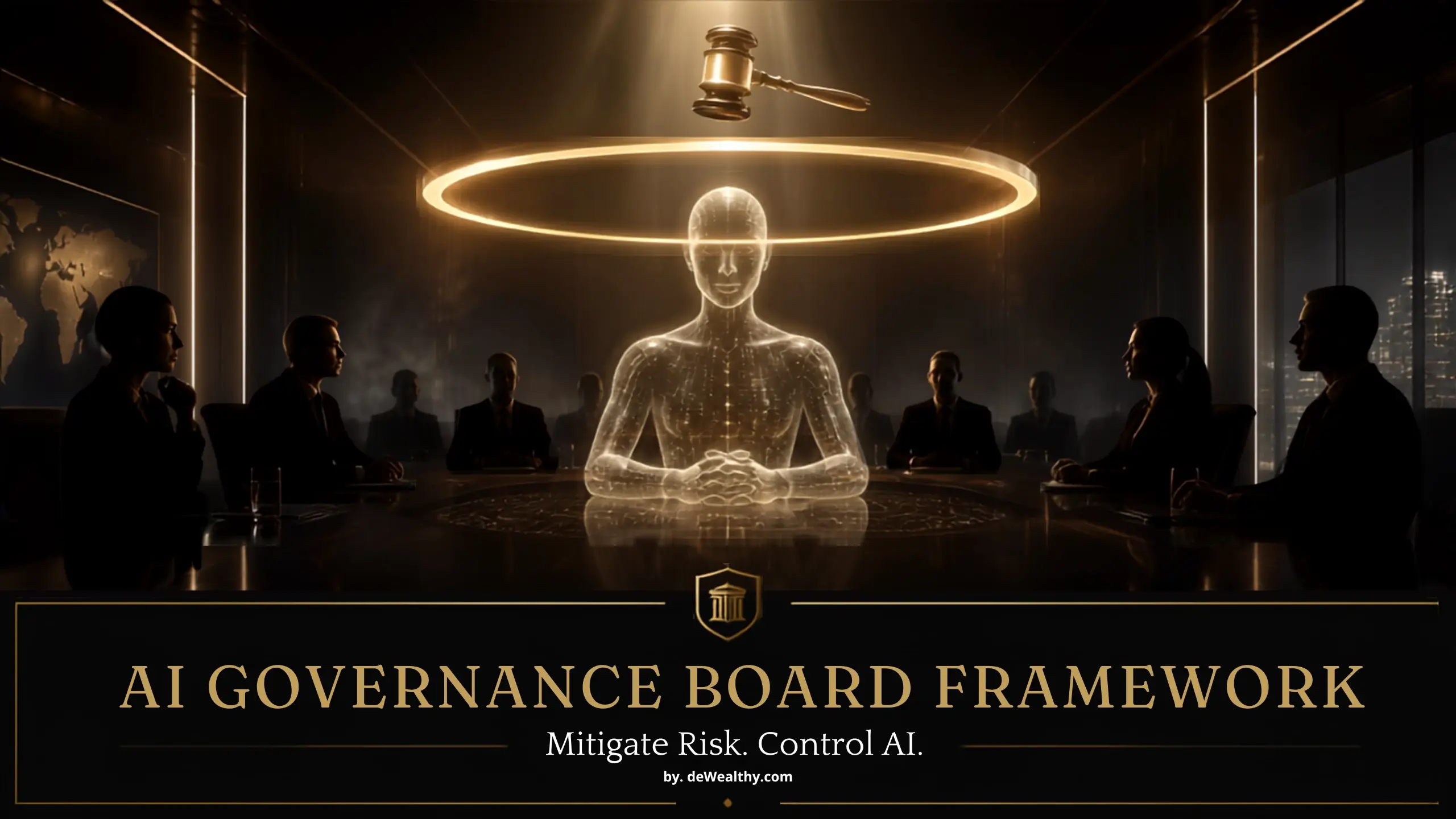
AI Governance Board Framework: Corporate Risk Management
AI Governance Board
Framework: Mitigate Risk
Control enterprise AI risks. An AI governance board framework protects C-suite executives from regulatory fines and algorithmic bias.
RISK NODE · High-risk classification triggers
SAFE NODE · Documentation & compliance checkpoints
TL;DR — the board that sees the algorithm
A hiring algorithm rejects 40% of female applicants. The model was trained on historical data that reflected past bias. The vendor assured the company it was “state of the art.” Six months later, a class action lawsuit names the CEO personally, the board is subpoenaed for minutes, and the D&O insurer invokes an AI exclusion clause buried in the renewal terms. This is not hypothetical — it is the pattern repeating across hiring, lending, insurance underwriting, and medical triage. The AI governance board framework is the only structure that converts reactive crisis management into proactive fiduciary oversight. It allows the C-suite to mitigate enterprise algorithmic risks before they materialize as lawsuits or regulatory enforcement; it protects C-suite from AI regulatory fines by establishing a documented duty-of-care defense that regulators and courts recognize; and it enables the organization to establish robust enterprise AI oversight that satisfies the EU AI Act, US state laws, and emerging shareholder expectations. The entire argument, in three lines:
Verbatim · retain as written
- Mitigate enterprise algorithmic risks.
- Protect C-suite from AI regulatory fines.
- Establish robust enterprise AI oversight.
The black box is now a boardroom issue
Three years ago, AI governance was a technical conversation between data scientists and legal counsel. Today, it is a fiduciary conversation at the board table. The EU AI Act imposes fines up to 7% of global revenue for non-compliance. US state attorneys general are pursuing algorithmic discrimination claims under existing civil rights statutes. And shareholders are filing derivative suits alleging that boards breached their duty of care by deploying high-risk AI without adequate oversight. The 2026 Executive Digital Asset Risk Index confirms that AI-related enforcement actions have increased 340% year-over-year, with board-level accountability as the common thread.
“The board approved the AI initiative. Nobody asked what data it was trained on, what it could not do, or who was responsible when it failed.”Composite deposition pattern · algorithmic liability cases
The seven layers of AI oversight
AI governance is not a single policy; it is a stack of interdependent layers. A failure at any layer compromises the entire structure, which is why this framework must be designed in tandem with the regulatory navigation map and the digital asset trust structure that holds the enterprise’s digital wealth.
Classification
The Risk Taxonomy & Regulatory Mapping
Before oversight can begin, every AI system must be classified against the EU AI Act’s risk tiers (unacceptable, high, limited, minimal), US state laws like NYC Local Law 144, and sector-specific regulations in healthcare, finance, and employment. The classification determines the governance cadence, documentation requirements, and board review frequency.
- Complete AI inventory: internal tools, vendor-provided systems, and planned deployments
- Risk classification against EU AI Act Annex III high-risk categories
- Mapping to US state laws: NYC LL144 (hiring), Colorado AI Act (insurance), Illinois BIPA (biometrics)
Charter
Board Committee Mandate & Authority
The board charter must be amended or a subcommittee charter created to explicitly assign AI oversight responsibilities. The charter defines who reviews what, how often, and with what authority to halt deployments or demand remediation. Without charter authority, oversight is advisory and unenforceable.
- Amendment to existing Risk or Technology Committee charter, or creation of dedicated AI Subcommittee
- Explicit authority to request documentation, interview technical staff, and escalate to full board
- Defined escalation paths for incidents, bias detection, and regulatory inquiries
Expertise
Board Competence & External Advisors
Most boards lack the technical expertise to evaluate algorithmic risk. The framework requires either recruiting board members with AI/ML backgrounds, providing targeted training to existing members, or engaging external advisors who can translate technical risk into fiduciary language. The board must understand enough to ask the right questions, even if it cannot evaluate the code itself.
- Board skills matrix assessment: AI/ML, data ethics, algorithmic fairness, regulatory compliance
- Targeted education program for non-technical directors
- Engagement of external AI ethics advisors or technical auditors for high-risk systems
Documentation
Model Cards, Bias Audits & Incident Logs
Every high-risk AI system requires a model card documenting training data sources, known limitations, intended use cases, and performance metrics across demographic groups. Bias audits must be conducted before deployment and periodically thereafter. Incident logs capture every failure, bias detection, or regulatory inquiry. This documentation is the board’s evidence of oversight.
- Standardized model card template for all high-risk deployments
- Pre-deployment bias audit by independent third party for high-risk systems
- Incident log with 48-hour board notification protocol for any algorithmic failure
Human-in-the-Loop
Override Authority & Escalation Protocols
High-risk AI systems must have defined human-in-the-loop protocols specifying which decisions require human review, what triggers escalation to human judgment, and who has override authority. The board must approve these protocols and verify they are operationally enforced, not merely documented.
- Decision matrix: which AI outputs are advisory, which are final, which require human sign-off
- Escalation triggers: confidence thresholds, demographic disparities, edge cases
- Override authority: who can halt an AI-driven decision and under what circumstances
Incident Response
The 48-Hour Protocol & Regulatory Notification
When an AI system fails, produces biased outcomes, or attracts regulatory attention, the board must be notified within 48 hours. The incident response plan defines who investigates, how root cause is determined, what remediation is required, and when regulators must be notified. This protocol must be tested annually through tabletop exercises.
- 48-hour board notification requirement for any algorithmic incident
- Root cause analysis protocol with technical and legal review
- Regulatory notification decision tree: when voluntary disclosure is required vs. optional
Insurance
D&O Coverage & AI Exclusions
Traditional D&O insurance policies are beginning to include AI-specific exclusions or sublimits. The board must review its D&O coverage annually to ensure it covers regulatory defense costs, algorithmic bias claims, and shareholder derivative suits arising from AI failures. Where exclusions exist, separate cyber-liability or technology E&O policies may be required.
- Annual D&O policy review for AI-specific exclusions or sublimits
- Negotiation of riders or separate policies for algorithmic liability
- Coordination with high-value property insurance bundling for comprehensive coverage
Mapping AI governance requirements by jurisdiction
| Jurisdiction | Primary Framework | High-Risk Definition | Board Accountability | Enforcement Mechanism |
|---|---|---|---|---|
| European Union EU AI Act | Risk-based classification with conformity assessment for high-risk systems | Annex III: employment, credit, law enforcement, biometrics, critical infrastructure | Providers & deployers must implement risk management systems; board oversight implied | Fines up to €35M or 7% global revenue; market surveillance authorities |
| United States State Patchwork | Sector-specific laws: NYC LL144 (hiring), CO AI Act (insurance), IL BIPA (biometrics) | Varies by statute; generally “automated decision tools” affecting rights or opportunities | Emerging case law on board duty of care; SEC disclosure guidance for public companies | State AG enforcement; private right of action in some statutes; class actions |
| United Kingdom Pro-Innovation | Sectoral regulators (FCA, CMA, ICO) issue guidance; no omnibus AI law | Defined by sector regulators; FCA focuses on financial services AI | Corporate governance code expects board oversight of material risks | Regulatory enforcement within sector; ICO for data protection aspects |
| Canada AIDA Proposed | Artificial Intelligence and Data Act (proposed); currently voluntary guidelines | “High-impact” AI systems to be defined by regulation | Proposed: officers & directors liable for violations; due diligence defense available | Proposed: fines up to $25M or 5% global revenue; criminal liability for recklessness |
| Singapore Model Framework | Model AI Governance Framework (voluntary); sectoral guidelines from MAS, IMDA | No statutory definition; risk-based approach encouraged | Corporate governance principles expect board risk oversight | Sectoral regulatory enforcement; no specific AI enforcement mechanism yet |
Local statutes, global accountability
The AI governance framework must adapt to local enforcement realities. Read your jurisdiction’s specific liability landscape.
For UK readers — sectoral regulators and the governance code
UK Corporate Governance Code · FCA AI guidance · CMA AI principles · Equality Act 2010
For UK readers, there is no omnibus AI statute yet — but there is sectoral enforcement. The FCA has issued guidance on AI in financial services, the CMA is scrutinizing algorithmic pricing, and the ICO enforces data protection aspects. The UK Corporate Governance Code expects boards to oversee material risks, which increasingly includes algorithmic decision-making. Where AI systems produce discriminatory outcomes, the Equality Act 2010 provides a private right of action, and class actions are emerging. Families with digital asset trust structures holding AI company equity must ensure governance at the portfolio company level.
How the framework adapts
- Map AI deployments to sectoral regulators: FCA for finance, CMA for competition, ICO for data.
- Ensure board minutes document AI risk deliberations to satisfy Corporate Governance Code expectations.
- Review D&O policies for AI exclusions; coordinate with insurance bundling strategies.
In Canada — AIDA’s proposed director liability
Artificial Intelligence and Data Act (proposed) · Personal Information Protection and Electronic Documents Act (PIPEDA) · Canadian Human Rights Act
In Canada, this works differently: the proposed Artificial Intelligence and Data Act (AIDA) would impose personal liability on officers and directors for violations, with a due diligence defense available if the board can demonstrate adequate oversight. This makes the governance framework not just best practice but a legal shield. Meanwhile, PIPEDA applies to AI systems processing personal information, and the Canadian Human Rights Act prohibits discriminatory automated decisions in federally regulated sectors.
How the framework adapts
- Prepare for AIDA by building the governance framework now; the due diligence defense requires contemporaneous documentation.
- Ensure AI systems comply with PIPEDA’s accountability principle; conduct privacy impact assessments for high-risk deployments.
- Coordinate with the SLIP39 key architecture to secure the documentation trail.
Australia — voluntary ethics and the Privacy Act reform
AI Ethics Principles (voluntary) · Privacy Act 1988 (reform pending) · Anti-Discrimination legislation (state & federal)
Australia has adopted voluntary AI Ethics Principles rather than prescriptive regulation, but the Privacy Act reform underway will impose stricter obligations on automated decision-making. State and federal anti-discrimination laws apply to algorithmic bias in employment, lending, and service provision. The Australian Human Rights Commission has issued guidance on AI and human rights, signaling future enforcement direction.
How the framework adapts
- Adopt the voluntary AI Ethics Principles as a governance baseline; document compliance for future regulatory defense.
- Prepare for Privacy Act reform by conducting algorithmic impact assessments for systems processing personal information.
- Ensure superannuation funds (SMSFs) holding AI equities have governance oversight at the fund level.
New Zealand — privacy, bias, and the Trusts Act intersection
Privacy Act 2020 · Human Rights Act 1993 · Trusts Act 2019
New Zealand’s Privacy Act 2020 includes provisions on automated decision-making, and the Human Rights Act prohibits discrimination in algorithmic systems. For families using NZ trusts to hold AI company equity or to deploy AI for trust administration, the Trusts Act 2019 disclosure duties create a tension: beneficiaries may have a right to know how algorithmic decisions affecting their interests are made, even if the underlying model is proprietary.
How the framework adapts
- Conduct privacy impact assessments for AI systems processing beneficiary or client data.
- Document the rationale for algorithmic decisions affecting trust distributions or investment allocations.
- Align AI governance disclosures with the trust’s beneficiary communication strategy.
United States — the state patchwork and SEC disclosure
NYC Local Law 144 · Colorado AI Act · Illinois BIPA · SEC AI disclosure guidance · state UDAP statutes
For US families and enterprises, the regulatory landscape is a patchwork. NYC Local Law 144 requires bias audits of automated employment decision tools. Colorado’s AI Act targets insurance underwriting. Illinois BIPA governs biometric AI. And the SEC has issued guidance expecting public companies to disclose material AI risks. Where AI failures cause harm, the litigation path often runs through third-party litigation funding arrangements, and the defense requires both technical documentation and board governance records.
How the framework adapts
- Map AI deployments to state-specific statutes; conduct bias audits for employment and insurance tools.
- For public companies or those considering IPO, prepare SEC-compliant AI risk disclosures.
- Review D&O policies for AI exclusions; ensure coverage for regulatory defense and class action settlements.
The governance library
Canada · Passive coreBest index funds in Canada: XEQT & VGROBuilding the compliant, non-algorithmic core of the family office portfolio.
UK · Tax wrappersISA investing for beginnersSheltering sterling while AI governance protects the digital sleeve.
UK · Household systemsBest UK budgeting appsThe operational tools for maintaining the household’s fiat liquidity.
Australia · SequencingSuperannuation vs ETF investingNavigating the regulatory boundary between SMSFs and personal AI tools.
Australia · LiquidityHigh-interest savings accounts AUProbate liquidity buffers held in APRA-regulated institutions.
New Zealand · RetirementKiwiSaver vs index fundsAligning retirement vehicles with the Trusts Act’s disclosure expectations.
Method · SeriesThe oversight layer methodHow AI governance integrates with regulatory navigation and trust architecture.
Three ways oversight fails
The vendor assurance trap
A financial services firm deployed a vendor-provided AI for loan underwriting. The vendor assured the board it was “state of the art” and “bias-tested.” When the system rejected minority applicants at 3x the rate of white applicants, the class action named the board for failing to independently verify the vendor’s claims. The board had no model card, no bias audit, and no documentation of what questions they asked the vendor.
The fix: Mandatory independent bias audit for all high-risk vendor-provided AI; model card documentation required before deployment; board minutes recording the specific questions asked and answers received.
The silent incident
An AI-powered trading algorithm executed a series of anomalous trades that caused a $40M loss. The technical team discovered the issue but did not escalate to the board because there was no formal incident response protocol. When regulators investigated, the board claimed it had no knowledge. The SEC enforcement action cited the board’s failure to establish reporting protocols as a governance failure.
The fix: 48-hour board notification protocol for any algorithmic incident causing >$1M loss or regulatory inquiry; quarterly incident log review at board meetings; annual tabletop exercise testing the escalation path.
The D&O exclusion surprise
A healthcare AI system misdiagnosed patients, leading to harm and a class action. The board’s D&O insurer invoked a newly added AI exclusion clause, leaving directors personally exposed. The board had not reviewed the policy renewal terms and was unaware the exclusion existed. Where such disputes arise, families increasingly rely on litigation funding to mount a defense.
The fix: Annual D&O policy review specifically for AI exclusions or sublimits; negotiation of riders or separate cyber-liability policies; coordination with high-value insurance bundling strategies.
The 90-day governance build
-
AI inventory & classification
Catalog every AI system in use or planned. Classify each against EU AI Act risk tiers, US state laws, and sector-specific regulations. This inventory is the foundation of all oversight.
Weeks 1–3
-
Board charter amendment
Amend the existing Risk or Technology Committee charter, or create a dedicated AI Subcommittee charter. Define authority, review cadence, and escalation paths. Obtain full board approval.
Weeks 4–6
-
Expertise gap analysis
Assess current board expertise against AI governance requirements. Recruit new directors, provide training to existing members, or engage external advisors. Document the expertise strategy in board minutes.
Weeks 7–9
-
Documentation framework
Establish standardized model card templates, bias audit requirements, and incident log protocols. Train technical staff on documentation requirements. Deploy the documentation infrastructure.
Weeks 10–11
-
Human-in-the-loop protocols
Define which AI decisions require human review, what triggers escalation, and who has override authority. Obtain board approval and communicate protocols to operational staff.
Week 12
-
Incident response plan
Build the 48-hour board notification protocol and regulatory response procedures. Conduct a tabletop exercise to test the plan. Document lessons learned and update the protocol.
Week 13
-
D&O insurance review
Review D&O coverage for AI-specific exclusions. Negotiate riders or separate policies where needed. Coordinate with the enterprise’s broader insurance bundling strategy.
Week 13 · then annually
Asked at the governance table
Under emerging frameworks like the EU AI Act and US state legislation, C-suite executives and board members can face personal liability for deploying high-risk AI systems without adequate oversight, documentation, or human-in-the-loop controls. D&O insurance may not cover regulatory fines if governance was absent.
The EU AI Act classifies systems as high-risk if they are used in critical infrastructure, employment decisions, credit scoring, law enforcement, or biometric identification. These systems require conformity assessments, risk management systems, human oversight, and detailed documentation before deployment.
Rarely. Traditional risk committees focus on financial, operational, and cybersecurity risks. AI governance requires specialized expertise in algorithmic bias, model drift, data provenance, and explainability. Most boards need a dedicated AI oversight subcommittee or expanded committee charter.
High-risk systems require quarterly board review with incident reporting. Medium-risk systems need semi-annual review. The governance framework should include mandatory board notification within 48 hours of any algorithmic incident, bias detection, or regulatory inquiry.
The board requires model cards (documenting training data, limitations, and intended use), bias audit reports, human-in-the-loop protocols, incident logs, and regulatory compliance certifications. This documentation must be maintained even if the AI is provided by a third-party vendor.
You can outsource the technical work, but not the accountability. The board retains fiduciary responsibility for oversight. Consultants can build the framework and conduct audits, but the board must formally adopt the framework, review reports, and document its deliberations to establish a duty-of-care defense.
Who stands behind this dossier
Methodology & standards
- Human-drafted, practitioner-reviewed line by line before publication.
- Statutory references checked against primary instruments at review date.
- AI regulatory frameworks are subject to rapid change; this dossier reflects the law as of August 2026.
- Material regulatory change triggers an out-of-cycle update.
The series · internal reading order
№ 17 · Digital Asset Trust Structure
№ 18 · SLIP39 Estate Planning
№ 19 · Regulatory Navigation
№ 20 · AI Governance Board Framework (this dossier)
№ 21 · High-Value Condo Insurance Bundling
№ 22 · Digital Asset Litigation Funding
№ 23 · Smart Contract Dispute · RWA
№ 24 · Executive Car Accident Lawyer
Data · 2026 Executive Digital Asset Risk Index
Hub · All Insights
Educational commentary, not legal, tax or investment advice. Engage qualified counsel in each relevant jurisdiction before acting. Full disclaimer applies.
Establish oversight before the algorithm becomes a liability.
Boards and C-suite executives can request the AI Governance Playbook — a working document covering charter templates, model card frameworks, bias audit protocols, and the 48-hour incident response procedure.
Response within 48 hours · NDA on request · No legal representation offered through this publication
/ai-governance-board-framework
© 2026 DeWealthy · Disclaimer · Privacy