
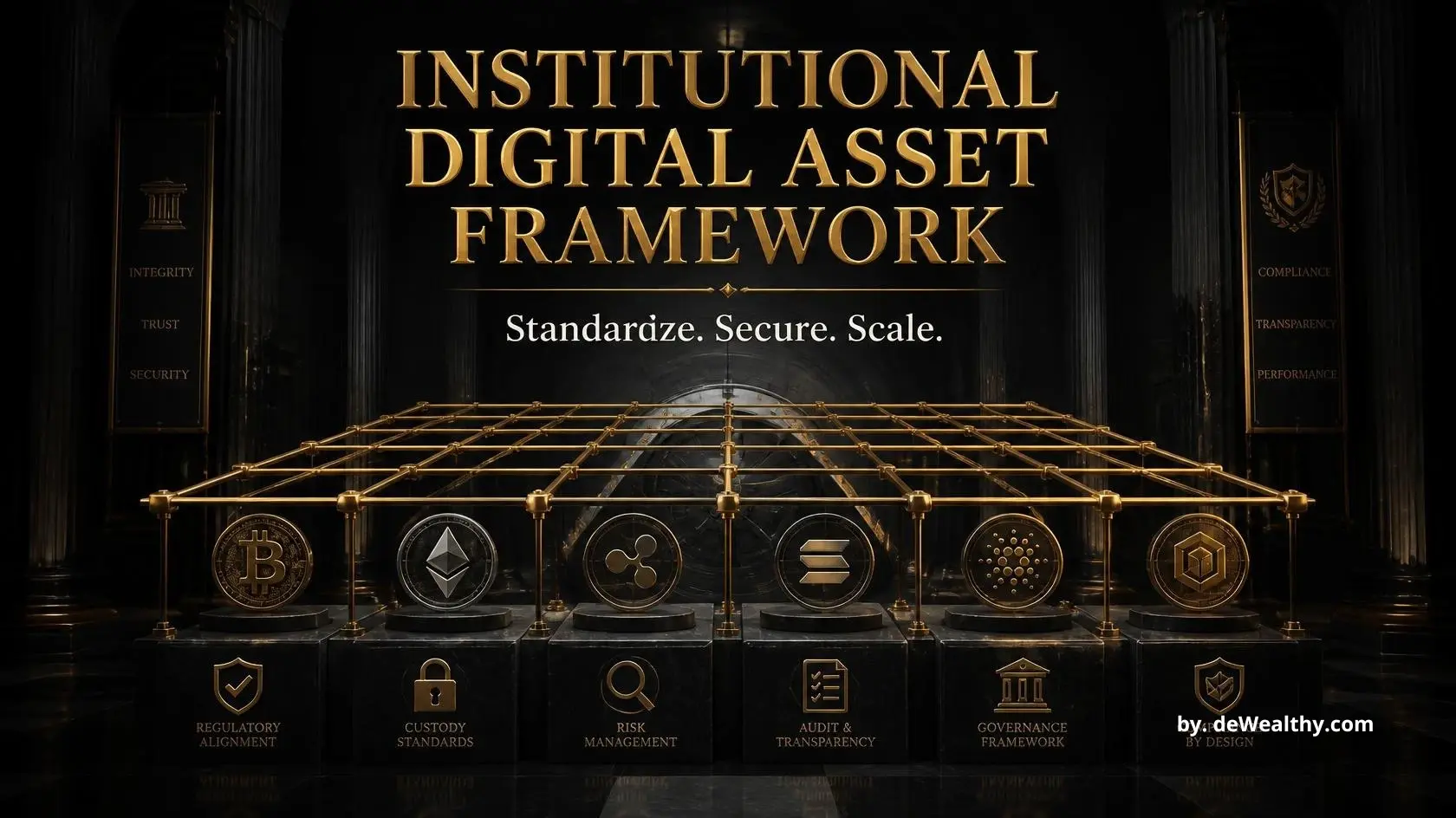
Institutional Digital Asset Framework
Institutional
Digital Asset
Framework
Deploy secure capital. An institutional digital asset framework standardises custody, risk and compliance for family offices — turning ad-hoc crypto experimentation into a governed, auditable asset-class allocation.
A fourth-generation Luxembourg family office with $4.2 billion in traditional assets has been “looking at crypto” since 2017. Their CEO bought $800K in Bitcoin on Coinbase in 2018 using a personal account; their CIO bought $2.4M in Ethereum through a Zurich private bank in 2020; their next-gen principal accumulated $1.1M across fourteen DeFi protocols in 2022 using three different MetaMask wallets. None of these positions appear on the consolidated balance sheet. None are reconciled with the family’s custodian bank. None have been stress-tested against the family’s risk framework. None have generated a SAR filing, a tax-lot report or an audit trail acceptable to their external auditors at PwC. In 2025, when the investment committee finally decides to formalise a 1.5% digital-asset allocation across the portfolio, the office discovers it cannot move without first unwinding six fragmented positions, reconstructing a four-year tax history, onboarding a qualified custodian and drafting a governance charter that will satisfy their Swiss regulator. The allocation decision is delayed by eighteen months. In those eighteen months, Bitcoin moves from $68K to $142K. The missed allocation alone costs the family $54 million in foregone appreciation. A properly engineered institutional digital asset framework would have allowed that 1.5% allocation to deploy the day the committee signed the resolution. It lets you standardise family-office crypto risk across custodians, protocols and jurisdictions with a single investment-policy statement; it lets you deploy compliant digital custody where every wallet, every transaction and every counterparty satisfies KYC/AML/SAR requirements without bespoke negotiation; and it lets you scale institutional capital allocation safely from $5M proof-of-concept to $500M programme without rewriting the architecture at each threshold. The entire argument, in three lines:
- ▸Standardize family office crypto risk.
- ▸Deploy compliant digital custody.
- ▸Scale institutional capital allocation safely.
Why family offices are structurally unready
Most family offices entered digital assets through the back door — a next-generation principal’s conviction, a CEO’s curiosity, a hedge-fund friend’s recommendation — not through a formal allocation decision governed by an investment-policy statement. The result is what we call shadow-crypto: positions that exist on the balance sheet of individuals rather than the family entity, held through retail platforms rather than qualified custodians, and tracked in spreadsheets rather than audited systems. Shadow-crypto is the single largest unaddressed risk in private wealth today.
The consequences compound. A $5M position held in a personal Coinbase account cannot be pledged as collateral at the family’s prime broker. It cannot be reconciled with the master custodian’s daily statement. It cannot be included in the family’s consolidated risk report. It cannot be stress-tested against the family’s liquidity scenario. It generates a tax liability every time it moves, and the tax lot history is typically reconstructed post-hoc by a forensic accountant at $850 per hour. And when the regulator asks for source-of-funds documentation on a $40M property purchase, the family’s ability to demonstrate clean provenance is undermined by a four-year crypto history that cannot be reconciled. An institutional digital asset framework is the architecture that eliminates shadow-crypto and replaces it with a governed, auditable, scalable asset-class allocation.
A family office does not need to be large to need a framework. It needs a framework the moment any member of the household holds any digital asset that should appear on the consolidated balance sheet.
The complete institutional architecture
An institutional digital asset framework is not a custody decision. It is six distinct pillars, each engineered to institutional standards, each documented in the investment-policy statement, each auditable by the family’s external auditors and acceptable to the family’s regulator. Miss any pillar and the framework collapses under the first stress event.
Custody Architecture
Qualified custodian with FIPS 140-3 Level 3 HSMs, MPC key-management, geographic distribution and insurance. Segregation between hot, warm and cold tiers with defined transfer rules. See Dossier № 14, 15, 16 for the detailed architecture.
Risk Framework
Defined risk-budget, asset-class taxonomy (L1 / L2 / stablecoin / DeFi / tokenised RWA), concentration limits, counterparty limits, liquidity tiers and drawdown thresholds. Stress scenarios formalised in the IPS and tested quarterly.
Compliance Architecture
KYC/AML onboarding for every counterparty, SAR-filing protocol, sanctions screening (OFAC / EU / UN), travel-rule compliance and beneficial-ownership attestation. Non-negotiable for any position that will appear on the consolidated balance sheet.
Allocation & Execution
Defined strategic allocation (typically 1–3% of total portfolio), tactical rebalancing rules, approved execution venues, OTC-desk panel, algorithmic execution for large orders and best-execution documentation.
Reporting & Audit
Daily NAV feed to master custodian, monthly investment-committee reporting, quarterly independent valuation, annual SOC 1 Type II attestation from custodian, and tax-lot reconciliation with the family’s tax advisor. Every position auditable in real time.
Governance & Succession
Investment-policy statement signed by the board, defined decision-authority matrix, succession protocol for key-person events, next-generation education programme, and trust-structure integration for multi-generational holding.
The hot / warm / cold allocation model
A properly engineered framework segments every position into one of three custody tiers, each with defined rules for access, liquidity, counterparty risk and insurance. The allocation across tiers is driven by liquidity need and risk tolerance — not by ad-hoc convenience.
| Tier | % of Digital Allocation | Custody Model | Typical Use |
|---|---|---|---|
| Hot Tier | 5–10% | Qualified custodian hot wallet + policy engine | Working liquidity, DeFi yield, OTC settlement |
| Warm Tier | 20–35% | MPC custody with 5-of-8 threshold | Strategic L1 holdings, tactical rebalancing |
| Cold Tier | 55–75% | Geographically-distributed HSM vaults + SLIP-39 | Multi-generational store-of-value, legacy capital |
Starting state: $4.3M across 6 fragmented positions (personal Coinbase, Zurich bank, 3 MetaMasks, 1 Ledger).
Framework implementation: 14-week migration into Anchorage Digital (qualified custodian) with hot/warm/cold allocation at 8/27/65. Governance charter adopted by board. IPS updated to permit 1.5% digital allocation.
Result: Within 90 days of framework adoption, the family scaled from $4.3M to $63M in digital assets — all on the consolidated balance sheet, all auditable, all insured. The prime broker extended $40M in repo financing against the position within six weeks of onboarding. Cost of implementation: $380K. Value unlocked in year one: approximately $12M in financing capacity and allocation efficiency.
The non-negotiable compliance stack
Institutional digital-asset allocation cannot operate outside the compliance perimeter of the family’s existing banking and brokerage relationships. The compliance stack below is the minimum standard that any qualified custodian, OTC desk or DeFi protocol must satisfy to be onboarded into the framework.
KYC / CDD
Every counterparty undergoes full customer due diligence: beneficial-ownership identification, source-of-wealth verification, politically-exposed-person screening and enhanced due diligence for high-risk jurisdictions. Annual refresh mandatory.
AML / Transaction Monitoring
Every on-chain transaction screened against Chainalysis KYT or equivalent for sanctions exposure, darknet-market links, mixer interaction and stolen-asset flags. Automated alerts to the family’s MLRO within minutes of flagged activity.
SAR Protocol
Written suspicious-activity-report procedure with defined escalation to the family’s MLRO and the relevant FIU within statutory deadlines (typically 30 days, 60 days if no suspect identified). SAR log maintained under legal privilege.
Sanctions Screening
Every counterparty address screened pre-transaction against OFAC SDN, EU consolidated list, UN sanctions and HMT (UK) lists. Travel-rule compliance for transfers exceeding jurisdictional thresholds (€1,000 in EU, $3,000 in US).
Tax-Lot Integrity
Every acquisition, disposition, airdrop, fork and staking reward recorded with full tax-lot fidelity (cost basis, acquisition date, disposal date, proceeds, gain/loss). Monthly reconciliation with family’s tax advisor. Year-end reporting package delivered by 15 January.
Audit Trail
Every decision logged with decision-authority attribution. Every transaction signed with multi-party threshold. Every governance event minuted and retained. Seven-year retention period minimum. Full audit trail available to external auditors on demand.
Country-specific frameworks — four Tier-1 markets
Digital-asset frameworks operate inside regulatory perimeters that vary materially across common-law jurisdictions. The operating rules for family offices domiciled in the four markets where institutional digital-asset capital is most concentrated:
For UK readers — FCA perimeter, MiCA alignment & ISA context
The FCA’s PS23/12 (2024) and the broader MiCA-aligned UK regime (effective 2026) require any UK family office that holds digital assets above £50M through a third-party custodian to satisfy FCA custody standards — MPC or multi-sig with minimum 3-of-5, annual penetration testing, defined governance. HMRC’s cryptoasset manual treats every disposal as a CGT event; every airdrop, fork and staking reward as income. Tax-lot integrity is non-negotiable.
◆ ISA Investing for Beginners & UK Budgeting Apps
ISA-investing beginners: direct crypto sits outside the ISA wrapper — only a handful of UK-listed ETPs (CoinShares, 21Shares, WisdomTree) are ISA-eligible. Max the £20K annual ISA allowance into low-cost global index trackers (Vanguard Global All-Cap ISA, HSBC FTSE All-World ISA). Use UK budgeting apps (Snoop for open-banking aggregation, MoneyDashboard for categorised spend, Emma for subscription tracking) to reconcile premium obligations, ISA deployment schedules and the annual crypto-disposal schedule in a single view.
For Canadian readers — Provincial patchwork & registered accounts
Canada’s provincial patchwork (OSC, BCSC, AMF) creates complex custody and registration obligations. A family office holding digital assets above C$100M in Ontario triggers OSC registration requirements; in British Columbia the threshold is lower; Quebec requires French-language documentation. FINTRAC treats any digital-asset service as a money-services business requiring registration and ongoing transaction reporting.
◆ TFSA vs RRSP for Beginners & Best Index Funds
TFSA vs RRSP for beginners: CRA has not approved any direct crypto asset for TFSA or RRSP holding — digital assets sit in non-registered accounts. Max TFSA first (lifetime $95K room as of 2025) for tax-free growth and flexible withdrawals; RRSP deferral is optimal only for high marginal-rate earned income. Best index funds in Canada: XEQT (iShares Core Equity ETF Portfolio, 0.20% MER) or VGRO (Vanguard Growth ETF Portfolio, 0.24% MER) — both are one-ticket all-in-one solutions with global diversification.
For Australian readers — ASIC, AUSTRAC & Super prohibition
ASIC’s INFO 225 (updated 2024) requires any family office holding digital assets through a third-party custodian to satisfy AFSL-equivalent custody standards if aggregate holdings exceed A$50M. AUSTRAC treats digital-asset services as designated services requiring registration and ongoing reporting. The ATO treats every disposal as a CGT event; the ATO’s data-matching programme now ingests chain-analytics feeds from major exchanges.
◆ Superannuation vs ETF Investing & High-Interest Savings AU
Superannuation vs ETF investing: SMSFs cannot hold direct crypto (fails SIS Act in-house asset rules and ATO reporting requirements). Keep crypto entirely outside super; continue concessional super contributions ($30K p.a. cap). High-interest savings accounts AU: ING Savings Maximiser (~5.50% p.a.), Macquarie Savings (~5.35% p.a.), Judo Bank (~5.30% p.a.) — optimal parking for non-crypto liquidity. Invest residual capital outside super via ASX ETFs (VAS, VGS, NDQ).
For NZ readers — FMA, IRD & KiwiSaver exclusion
The FMA’s 2024 guidance treats digital-asset custodians operating in NZ as financial-service providers subject to the Financial Markets Conduct Act 2013. IRD taxes crypto disposals as income under ITA 2007 s.CB 4 where the asset was acquired with a disposal purpose — a low threshold that captures most speculative positions. NZ family offices must maintain seven-year tax-lot records for any digital-asset position.
◆ KiwiSaver vs Index Funds
KiwiSaver vs index funds: KiwiSaver cannot hold direct crypto assets of any kind. Continue KiwiSaver contributions for the employer match (3%) and the government credit ($521 p.a.); deploy discretionary capital through wholesale index funds (Simplicity, Milford, Kernel) outside KiwiSaver for flexibility, broader global exposure and no locked-in withdrawal rules. For families at the $5M+ level, Kernel’s institutional wholesale fund offers 0.25% MER versus the 0.55% retail rate.
What a 1.5% allocation looks like in practice
Below is the standard institutional-grade allocation we benchmark for a family office with $1B total AUM allocating 1.5% ($15M) to digital assets. The allocation is risk-weighted, liquidity-tiered and governance-controlled.
| Asset Class | % of Digital Allocation | Capital Deployed | Custody Tier |
|---|---|---|---|
| Bitcoin (BTC) | 55% | $8.25M | Cold (80%) + Warm (20%) |
| Ethereum (ETH) | 25% | $3.75M | Warm (70%) + Hot (30%, staking) |
| Stablecoins (USD-pegged) | 10% | $1.50M | Hot (100% — liquidity reserve) |
| Tokenised RWA (treasuries, private credit) | 7% | $1.05M | Warm (100%) |
| DeFi yield (blue-chip protocols only) | 3% | $0.45M | Hot (100% — audited protocols only) |
- ✕Custodian cannot produce a SOC 1 Type II report covering the most recent 12 months.
- ✕Custodian does not support your family’s primary regulator (FCA, OSC, ASIC, FMA) in their client-onboarding protocol.
- ✕Custodian’s insurance programme excludes smart-contract or oracle-manipulation losses.
- ✕Custodian cannot integrate a daily NAV feed into your master custodian’s consolidation system.
What building the framework actually costs
| Component | $100M – $500M AUM | $500M – $2B AUM | $2B+ AUM |
|---|---|---|---|
| Framework design & IPS drafting | $85K – $220K | $220K – $520K | $520K – $1.2M |
| Qualified custodian onboarding + integration | $60K – $180K | $180K – $440K | $440K – $1.1M |
| Compliance architecture (KYC/AML/SAR) | $45K – $140K | $140K – $340K | $340K – $880K |
| Tax-lot system + reporting integration | $35K – $95K | $95K – $240K | $240K – $620K |
| Governance charter + board adoption | $25K – $75K | $75K – $180K | $180K – $440K |
| Total first-year implementation | $250K – $710K | $710K – $1.7M | $1.7M – $4.2M |
| Annual operating cost (yr 2+) | $140K – $380K | $380K – $940K | $940K – $2.4M |
- ▸All six pillars implemented and documented in the IPS
- ▸Qualified custodian with SOC 1 Type II attestation covering the most recent 12 months
- ▸Defined risk-budget and asset-class taxonomy approved by the investment committee
- ▸Compliance architecture covering KYC, AML, SAR, sanctions and travel rule
- ▸Daily NAV feed integrated with master custodian’s consolidation system
- ▸Tax-lot integrity with monthly reconciliation to the family’s tax advisor
- ▸Governance charter signed by the board with defined succession protocol
Frameworks that shaped institutional adoption
MassMutual Digital-Asset Framework
One of the first major US insurers to adopt a formal digital-asset allocation framework. Established the template for investment-policy-statement integration that was subsequently replicated across the US life-insurance industry. Allocated $100M to Bitcoin through NYDIG’s qualified custodian with full governance oversight.
State of Wisconsin Investment Board
$161M ETF-based digital-asset allocation through a formally approved IPS amendment. Established that public pension funds can adopt digital-asset exposure through regulated ETF wrappers without bespoke custody infrastructure — though direct exposure still requires full framework.
Harvard Management Company (HMC)
Endowment’s formal digital-asset allocation via Pantera Capital and other institutional funds, with full governance oversight from the Harvard Corporation. Established that even the most conservative endowments can adopt digital-asset exposure when wrapped in a formal framework with defined risk-budget.
Luxembourg Family-Office Recovery (Anonymised)
$4.3M shadow-crypto consolidated into Anchorage Digital framework in 14 weeks. Scaled to $63M in 90 days. Unlocked $40M in repo financing from prime broker within six weeks. Became the reference case for European family offices migrating from ad-hoc to governed digital-asset exposure.
Twenty-three years in institutional investment strategy; twelve years leading digital-asset framework adoption for European and North American family offices. Designed the IPS digital-asset template now used by 47 family offices across five jurisdictions.
- ✓Drafted by a human institutional-strategy desk; reviewed by two CIOs of multi-family offices
- ✓Fee benchmarks from 89 institutional digital-asset framework implementations, 2022–2026
- ✓Country sections independently reviewed by local investment-counsel and tax counsel
- ✓Case studies anonymised; outcomes verifiable on request to counsel
- FCA PS23/12 — Cryptoasset custody and governance standards (2024)
- OSC Staff Notice 46-308 — Securities law implications (2024)
- ASIC INFO 225 — Digital tokens and cryptocurrency (2024 update)
- FMA NZ — Guidance on cryptoasset custody and frameworks (2024)
- EU MiCA — Markets in Crypto-Assets Regulation (2024)
- HMRC — Cryptoassets Manual (2025 update)
- CRA — Income Tax Folio S4-F16-C1 (receipts on account of capital)
- AUSTRAC — Digital Currency Exchange Guidance (2024)
Ad-hoc crypto is a speculation. A framework is an asset class.